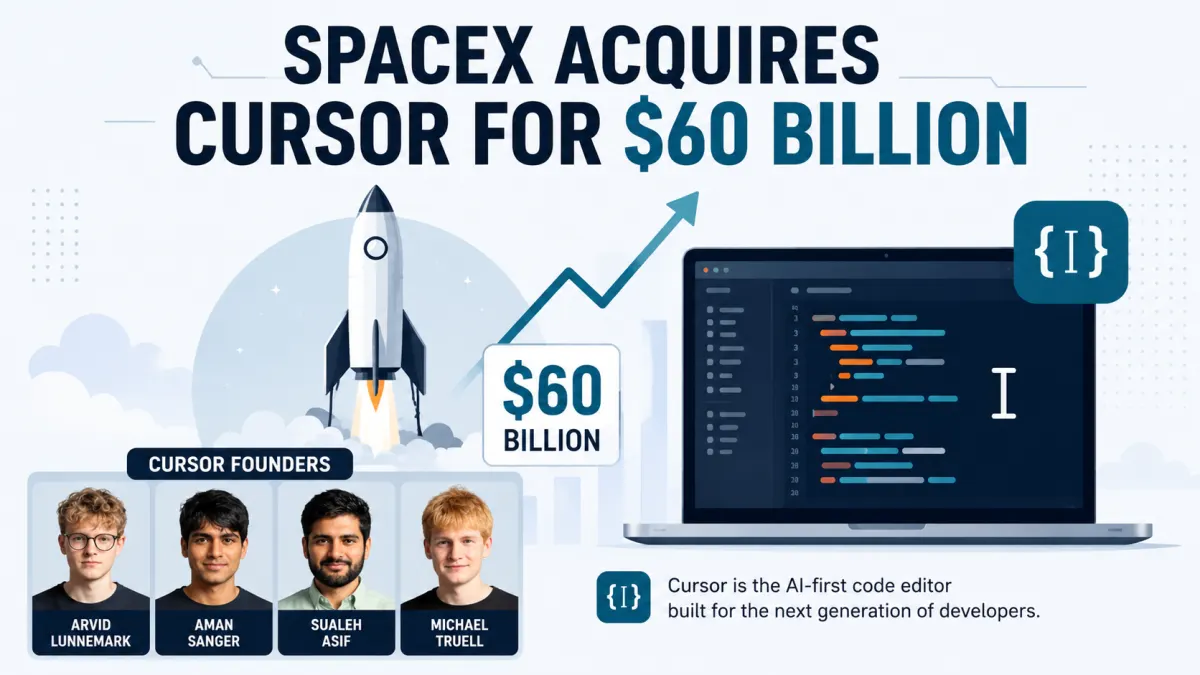
Four years ago, a 22-year-old from Karachi sat in a dorm room at MIT, tinkering with code alongside three classmates. Today, that side project — an AI-powered coding tool called Cursor — is about to become a wholly owned subsidiary of SpaceX, in a deal that values the four-year-old startup at $60 billion. For Pakistan's tech community, this isn't just another Silicon Valley headline. It's proof that a kid from a middle-class Karachi household can end up reshaping how the world's software gets written — and sit at the table with Elon Musk while doing it.
This is the story of Cursor, the company behind it, and Sualeh Asif, the Pakistani co-founder whose journey from Nixor College to a multi-billion-dollar AI empire is one of the most remarkable in recent startup history.
What Happened
On June 16, 2026, SpaceX formally announced it was acquiring Cursor — built by a company called Anysphere — in an all-stock transaction valuing the AI coding startup at $60 billion. The announcement came just days after SpaceX's own record-breaking Nasdaq debut, the largest IPO in Wall Street history, which raised $75 billion. In the days that followed, SpaceX's stock surged so sharply that its market capitalization touched as high as $2.94 trillion in early trading — briefly overtaking Microsoft and leapfrogging Amazon — before settling around $2.65 trillion by the close.
The roots of the deal go back to February 2026, when SpaceX merged with Elon Musk's AI company xAI in a $1.25 trillion transaction, and to an April 2026 agreement that gave SpaceX the option to either buy Cursor outright for $60 billion later in the year, or pay a $10 billion fee to continue working together if it chose not to. With SpaceX's stock soaring after its IPO, exercising the buyout option became, in effect, almost free for Musk — the company's share price gains in the days after listing comfortably covered the entire purchase price.
Under the terms of the deal, Cursor's investors will receive SpaceX shares calculated against the company's volume-weighted average price in the week before closing. The acquisition is expected to close in the third quarter of 2026, after which Cursor will operate as a SpaceX unit, while continuing to serve its existing developer and enterprise customer base.
Why It Matters
This deal matters for three reasons. First, it's one of the largest acquisitions of a venture-backed startup in history — a four-year-old company built initially as a fork of VS Code is now worth more than entire industries. Second, it cements AI-assisted coding as one of the few AI applications generating serious, durable revenue rather than just hype; Cursor crossed $1 billion in annualized revenue in November 2025 and had climbed past $2 billion by the time the SpaceX deal closed seven months later — one of the fastest revenue ramps any software company has ever recorded. Third, and most personally for TecSpectrum's readers, it puts a Pakistani-born founder at the center of one of the biggest tech stories of the year — a rare and meaningful data point for a country often associated with brain drain rather than building category-defining companies.
Industry Impact
Cursor's rise mirrors the broader explosion of "vibe coding" — a term used to describe developers, and increasingly non-developers, building software by describing what they want in plain language rather than typing every line themselves. Cursor's "Tab" model predicts a programmer's next edit, its agent mode can complete entire tasks autonomously, and its recently released Composer 2.5 model was described internally as a substantial leap in handling long, complex coding tasks.
But the competitive landscape has tightened considerably. According to spending data tracked by the corporate card company Ramp, Cursor's share of the AI coding tools market slipped from roughly 41% in June 2025 to about 26% by May 2026 — driven mainly by Anthropic's Claude Code, which has grown so fast it now accounts for roughly half of all AI-coding-tool spending Ramp tracks, with GitHub Copilot and OpenAI's offerings also cutting into Cursor's lead. The SpaceX acquisition is widely read as Musk's attempt to give his AI ambitions, built around the Grok models and the Colossus supercomputer in Memphis, a coding product with genuine enterprise traction — something neither Grok nor its related tools had managed to build on their own.
Business Impact
For enterprises, the acquisition is unlikely to change much in the immediate term. Cursor says it's used by more than 50,000 enterprises and 64% of the Fortune 500, including engineering teams at Nvidia, Adobe, Uber and Shopify. SpaceX has indicated Cursor will keep operating largely as-is while becoming a subsidiary, and the two companies say they've already been jointly training a new AI model on Colossus, xAI's 100,000-GPU supercomputer — expected to ship inside both Cursor and xAI's Grok Build product soon.
The deal is also a major win for Cursor's existing investors. Thrive Capital, which holds stakes in both SpaceX and Cursor, now sees a combined position reportedly worth more than $10 billion. Cursor had been on track to close a separate $2 billion funding round (at a roughly $50 billion valuation) before SpaceX's offer arrived — meaning early backers effectively secured a better outcome through the acquisition than through continued independent fundraising.
The Karachi Connection
The story's most compelling thread, for Pakistani readers, is co-founder Sualeh Asif. Originally from Karachi, Asif studied at Nixor College before heading to MIT, where he represented Pakistan at the International Mathematical Olympiad between 2016 and 2018 — a credential that speaks to the kind of raw analytical talent that later went into building Cursor's underlying AI systems. While still a student, he had already founded an AI-powered search engine company before teaming up with Michael Truell, Arvid Lunnemark and Aman Sanger to start Anysphere in 2022.
Former federal IT minister Umar Saif put it plainly in a public post, calling Asif "the kind of role model Pakistani youth needs — not property dealers, tax evaders, bank defaulters, rent seekers, born into wealth — but a self-made kid from a middle-class family in Karachi," who "studied at MIT, started a hugely impactful company, changed the way people write code, now worth over $1 billion at the age of 26." With the SpaceX deal, Asif's stake in a company now valued at $60 billion places him among the youngest self-made billionaires to emerge from Pakistan's diaspora — built not through inheritance or government contracts, but through a coding tool used by millions of developers worldwide.
Future Outlook
The deal still needs to clear regulatory review, with both companies targeting a close in Q3 2026. Assuming it goes through, expect Cursor to lean more heavily on SpaceX's Colossus compute to train larger, more capable coding models, while gaining a built-in distribution channel into xAI's Grok ecosystem. There's also speculation, reported in early coverage of the deal, that the combined entity may push into adjacent territory — including a possible code-hosting platform that would compete directly with GitHub.
For Cursor's rivals, the acquisition raises the stakes considerably. A coding tool backed by one of the most cash-rich companies on the planet, with access to a dedicated AI supercomputer, changes the competitive calculus for every other player in the AI coding space — and likely accelerates consolidation across the sector over the next 12 to 18 months.
TecSpectrum Analysis
What makes this story worth more than a passing glance is what it signals about where value is actually being created in the AI boom. Plenty of AI startups have raised enormous sums on promise alone; Cursor raised enormous sums on top of real, recurring revenue from real engineering teams. That distinction is exactly what matters most when evaluating which AI companies are durable versus which are simply well-funded.
There's also a sharper lesson here for Pakistan's startup ecosystem. Sualeh Asif didn't build Cursor in Karachi, and that's worth being honest about — the capital, networks and computing infrastructure that made this outcome possible exist overwhelmingly in Silicon Valley, not at home. But his trajectory — competitive mathematics, a strong undergraduate foundation, and the willingness to build rather than just consume technology — is a replicable blueprint, not a one-off accident. The opportunity for Pakistan isn't to claim Cursor as a "Pakistani company"; it's to ask what it would take to keep more of that talent building locally, or at least to keep more of its upside flowing back home.
Key Takeaways
- SpaceX has agreed to acquire AI coding startup Cursor (Anysphere) for $60 billion in an all-stock deal, expected to close in Q3 2026.
- Cursor co-founder Sualeh Asif is originally from Karachi, Pakistan, and studied at Nixor College before MIT.
- Cursor crossed $1 billion in annualized revenue in November 2025 and had climbed past $2 billion by the time of the deal, and is used by over 50,000 enterprises including Nvidia, Adobe, Uber and Shopify.
- The deal follows SpaceX's record-breaking IPO and an April 2026 partnership that gave SpaceX the option to acquire Cursor or pay a $10 billion break fee.
- Cursor's AI coding market share has slipped amid intensifying competition, particularly from Anthropic's fast-growing Claude Code, even as its revenue keeps climbing.
Frequently Asked Questions
What is Cursor AI?
Cursor is an AI-powered code editor and coding agent, built by a company called Anysphere, that helps developers write, edit and debug software using natural-language instructions.
Who founded Cursor, and is there really a Pakistani connection?
Cursor was founded in 2022 by four MIT students — Michael Truell, Sualeh Asif, Arvid Lunnemark and Aman Sanger. Asif, the company's co-founder, is originally from Karachi, Pakistan, and attended Nixor College before MIT.
How much is SpaceX paying to acquire Cursor?
SpaceX agreed to acquire Cursor for $60 billion in an all-stock deal, with Cursor's investors receiving SpaceX shares based on that valuation.
Why does SpaceX want to buy an AI coding startup?
SpaceX's AI division, built around Elon Musk's xAI and the Grok models, wanted Cursor's strong enterprise developer base and proven revenue to strengthen its position against rivals like Anthropic and OpenAI.
When will the SpaceX-Cursor deal close, and will Cursor change for users?
The deal is expected to close in the third quarter of 2026, pending regulatory approval. Cursor is expected to continue operating largely as it does today, while becoming a SpaceX subsidiary.