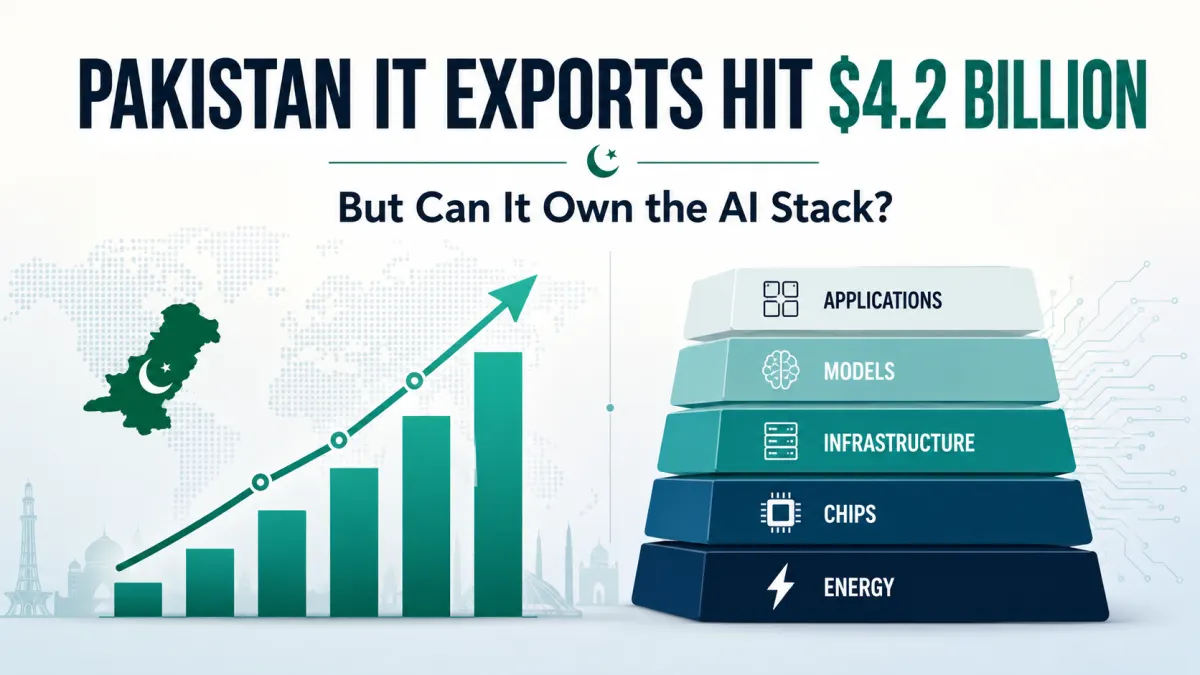
Pakistan has crossed a milestone that would have seemed ambitious just two years ago: technology exports surpassing $4.2 billion in a single fiscal year, with freelancer earnings hitting a record $1.6 billion on top of that. On paper, these are the best numbers Pakistan's tech sector has ever produced. But here is what the headline figures don't tell you — the global AI revolution is systematically automating away exactly the kind of work Pakistan has built its export engine on. And the experts paying closest attention aren't celebrating. They're sounding the alarm.
Two conversations published this week — one about Pakistan's record IT export numbers, another about what it will actually take to survive the AI era — tell a single coherent story about a country standing at a fork in the road, with one path leading to sustained digital prosperity and the other leading toward the same structural collapse that has quietly gutted parts of India's legacy outsourcing industry.
What Happened
Pakistan's tech exports rose 20% year-on-year to $4.2 billion in the first eleven months of fiscal year 2026, according to Finance Adviser Khurram Schehzad, who announced the figures via official channels in mid-June 2026. May 2026 alone recorded $373 million — a 13% increase over the same month the previous year. The government now expects total tech exports to exceed $4.5 billion for the full fiscal year, which would represent a record for the sector and a substantial acceleration from the $3.8 billion recorded in FY2024-25.
Freelancers have been a particularly strong driver of that growth. Pakistani freelancers generated $1.6 billion in foreign exchange earnings during the first eleven months of FY2026 — an 80% year-on-year surge, with May alone recording $169 million (up 87% from the prior year). Broadband connections, the infrastructure backbone of this digital economy, have climbed from under two million to over five million in a relatively compressed timeframe.
Those numbers arrive against a backdrop of Pakistan pursuing export-led growth under a $7 billion IMF loan program, making the IT sector's performance not just commercially important but strategically significant for macroeconomic stabilization.
Separately, a candid assessment published by Business Recorder pulled together the views of two senior tech industry leaders — Liaquat Ali, Founder of LA Consulting Corporation, and Tahir Mahmood Chaudhry, President of the Computer Society of Pakistan — on what it will take to sustain and deepen that growth. Their message was more cautious than celebratory, and considerably more structural.
Why It Matters
The reason these two stories belong together is simple: Pakistan's IT export numbers are real, but the business model generating them is fragile. Both experts make the same core point in different language — Pakistan is currently competing almost entirely at the applications layer of the global AI stack, which is the layer most exposed to automation. Selling developer hours and freelance services is not the same as owning technology. And as AI tools commoditize the kind of work that Pakistan's freelancers and software houses have traditionally supplied, labour arbitrage — the economic advantage of offering cheaper human labour than Western markets — will no longer be a defensible competitive position.
This is not speculation. It is happening in real time. India's legacy IT outsourcing industry has already felt this pressure acutely; the business process outsourcing and low-cost data entry models that once underpinned its global identity are being automated out of existence. Pakistan, which has followed a similar development path, is watching that disruption from a shorter distance than it realises.
The $4.2 billion figure is evidence that Pakistan has momentum. The question the experts are asking is whether the country has the right foundation to sustain it — or whether it's accelerating toward a wall.
Industry Impact: The Five-Layer Stack Pakistan Must Climb
Liaquat Ali's framework is worth understanding in detail because it provides the clearest map of where Pakistan actually stands and what it would take to build durable competitive advantage.
The global AI economy runs on a five-layer stack: energy, chips, infrastructure, models, and applications. At the moment, Pakistan competes almost exclusively at the applications layer — the top of the stack, and the layer most exposed to disruption from the layers below it. Every other layer is owned predominantly by the United States, China, and a small number of Gulf sovereign wealth funds moving aggressively to catch up.
The implications are stark. At the energy layer, Pakistan's national grid cannot reliably deliver the power uptime that data centers require — meaning any data center incentive policy issued before the energy problem is solved will produce empty facilities. At the chips and infrastructure layers, Pakistan cannot buy its way in alone, but bilateral compute-access agreements with Saudi Arabia and the UAE offer a realistic path. Saudi Arabia's sovereign wealth fund, PIF, is committing $100 billion to AI infrastructure under a program called Project Transcendence — the kind of capital Pakistan could partner with, rather than try to replicate independently.
At the models layer — the layer that determines long-term leverage — the recommendation is unambiguous: Pakistan must own Urdu-language AI models, not license them from American or Chinese vendors who will not prioritize Urdu, Punjabi, Sindhi or Pashto. This is not just a cultural point; it is a strategic and economic one. Proprietary models trained on Pakistan's languages, legal frameworks, and financial systems generate defensible export value. Licensed models generate dependency. The Islamabad AI Declaration of February 2026, adopted at the Indus AI Summit, formally frames sovereign AI — owning model weights, training data, and inference infrastructure — as Pakistan's national objective. The declaration commits $1 billion to AI development by 2030, though experts note the gap between declaration and delivery will be determined by whether Parliament actually locks the budget for five years rather than allowing it to shift with each administration.
Business Impact
For Pakistan's tech sector — software houses, AI startups, and the freelancer economy collectively — the near-term picture is genuinely positive but concentrated in ways that should concern policymakers.
Tahir Mahmood Chaudhry's point about the freelancer community is well-taken: Pakistan's digital identity on the global stage has become synonymous with freelancing, which is an achievement but an insufficient ambition. The next phase of growth requires a fundamental shift from task-based work toward proprietary software products, SaaS platforms, and owned intellectual property. Companies selling developer hours compete on price; companies selling software compete on capability. The former get automated; the latter often benefit from automation.
The structural gap between Pakistan's current output and its stated $10 billion IT exports target is real and large. A talent pool of 600,000 tech professionals is a genuine asset, but Chaudhry's assessment of the university system is blunt: a substantial proportion of computer science graduates are arriving in the labour market trained for a technology landscape that no longer exists. Curricula designed around syntax and legacy frameworks, rather than AI architecture and systems thinking, are producing graduates who are competitive for jobs that AI is eliminating.
The business opportunity in this transition is significant, however. Target verticals identified by experts — Islamic financial technology, South Asian agricultural technology, and Urdu-language AI — are sectors where Pakistan has structural advantages that American or Chinese vendors do not. Fintech built natively on Islamic finance principles, or agriculture AI trained on the specific conditions of South Asian cropping patterns, represents the kind of proprietary value that can generate USD-denominated export revenue for decades.
Notable Voice: Umar Saif, Liaquat Ali, and What Cursor Tells Us
It's worth noting that the Pakistan AI conversation this week doesn't exist in isolation from the broader global AI story. Earlier this month, TecSpectrum covered the SpaceX acquisition of Cursor — the AI coding tool co-founded by Karachi-born Sualeh Asif — for $60 billion. Former IT Minister Umar Saif's public praise of Asif as the role model Pakistani youth needs wasn't just sentiment: it was a pointed observation about what Pakistan's talent is capable of when given access to capital, compute, and global networks.
The uncomfortable corollary of that story is the one Ali makes explicitly: Pakistan cannot keep exporting its best mathematical minds to MIT and then celebrating their success from a distance. The country needs the talent, the models, and the infrastructure to be Pakistani assets — not just Pakistani-born founders building American companies on American infrastructure, however proud that achievement is.
Future Outlook
The government's target of $4.5 billion for the full fiscal year 2026 looks achievable based on the trajectory so far. Beyond that, reaching $10 billion will require the structural changes that both experts describe — and those changes are measured in years, not quarters.
Several policy interventions have clear timelines attached. Special Technology Zones Authority amendments to allow USD-denominated foreign currency retention need to pass within 12 months, according to Ali, or the investment case for high-value tech parks weakens significantly. The National AI Policy 2025 allocates 30% of the Ignite R&D fund to AI; locking that allocation for five years via Parliamentary action, rather than ministerial notification, is the difference between a policy and a commitment.
On the Gulf compute access front, the window is open but not permanent. Saudi Arabia and the UAE are building AI infrastructure at extraordinary scale right now; Pakistan's ability to negotiate bilateral access agreements while those programs are in construction phase is meaningfully better than it will be once those assets are fully committed to other partnerships.
Perhaps the most significant long-term variable is the brain drain question. The Pakistan AI Centers of Excellence framework targets training between 100,000 and 150,000 AI-skilled graduates annually — a number that is ambitious but achievable. What happens to those graduates after training depends entirely on whether Pakistan can offer USD-denominated retention incentives, stock options, and foreign currency accounts that make staying home competitive with leaving.
TecSpectrum Analysis
The $4.2 billion figure deserves to be celebrated — it is real money, earned in a globally competitive market, and it reflects the hard work of hundreds of thousands of Pakistani developers, designers and freelancers operating in a difficult domestic environment. That is not a small thing.
But TecSpectrum's honest assessment is that Pakistan is at approximately the same position in the AI era that India was in the early 2000s in the outsourcing era: growing fast on a model that is structurally time-limited. India's IT giants — Infosys, Wipro, TCS — survived the disruption of their original model because they spent two decades building proprietary platforms, acquiring IP, and moving up the value chain. Pakistan has not yet had two decades of that investment, and the disruption is already arriving.
The five-layer framework is the right mental model, and Ali's insistence on "layer sequence" — energy before data centers, infrastructure before models, models before applications strategy — is the kind of disciplined thinking Pakistani policymakers rarely apply to technology. The Islamabad AI Declaration is a more serious document than most such declarations, but its authors are correct to treat it as a starting pistol rather than a finish line.
The specific bets TecSpectrum thinks are most underrated: Urdu-language foundation models (first mover advantage in a language spoken by 230+ million people globally), Islamic fintech AI (a genuinely defensible moat in a global market that Western vendors design around), and bilateral GPU access agreements with Gulf sovereign funds that are actively looking for partnership narratives. These aren't hypotheticals — they are adjacent to conversations already happening. The question is whether Pakistan's government can execute at the speed the moment requires.
Key Takeaways
- Pakistan's IT exports reached $4.2 billion in the first 11 months of FY2026, up 20% year-on-year, with the full year expected to exceed $4.5 billion.
- Pakistani freelancers generated $1.6 billion in foreign exchange earnings during the same period, an 80% year-on-year increase.
- Tech experts warn that Pakistan currently competes only at the applications layer of the AI stack — the most vulnerable to automation — and must move up all five layers to sustain growth.
- The Islamabad AI Declaration (February 2026) commits Pakistan to $1 billion in AI investment by 2030 and frames sovereign AI — owning model weights, data, and infrastructure — as the national objective.
- Bilateral compute-access agreements with Saudi Arabia and UAE, and Urdu-language foundation models, are identified as Pakistan's most strategically defensible paths forward.
- Without USD-denominated retention incentives, investment in training AI talent risks funding a brain drain rather than a domestic AI ecosystem.
Frequently Asked Questions
How much has Pakistan's IT sector grown in 2026?
Pakistan's technology exports rose 20% year-on-year to $4.2 billion in the first eleven months of fiscal year 2026, with the full year expected to cross $4.5 billion. Freelancer earnings added another $1.6 billion on top.
What is the five-layer AI stack, and why does it matter for Pakistan?
The five-layer AI stack runs from energy and chips at the base, through infrastructure and models, to applications at the top. Pakistan currently competes almost exclusively at the applications layer — the most exposed to AI automation — and needs to build or access the lower layers to remain competitive as AI commoditizes software services.
What is the Islamabad AI Declaration?
The Islamabad AI Declaration was formally adopted in February 2026 at the Indus AI Summit. It defines Pakistan's national AI strategy around nine foundational principles of sovereign, responsible, and capability-driven AI development, and commits $1 billion to AI infrastructure, models, and talent by 2030.
How does Pakistan compare to India in the IT sector?
India's legacy IT outsourcing model — built heavily on labour delivery rather than proprietary IP — is undergoing structural disruption as AI automates the same tasks. Pakistan, which followed a similar development path, is being advised to learn from India's experience and pivot toward owned software products, SaaS platforms, and foundation models before the same disruption arrives.
What are Pakistan's biggest opportunities in AI?
Experts point to three high-value verticals with natural advantages for Pakistan: Islamic financial technology, South Asian agricultural AI, and Urdu-language foundation models. Each represents a category where Pakistani developers have domain knowledge that large American or Chinese AI vendors lack.