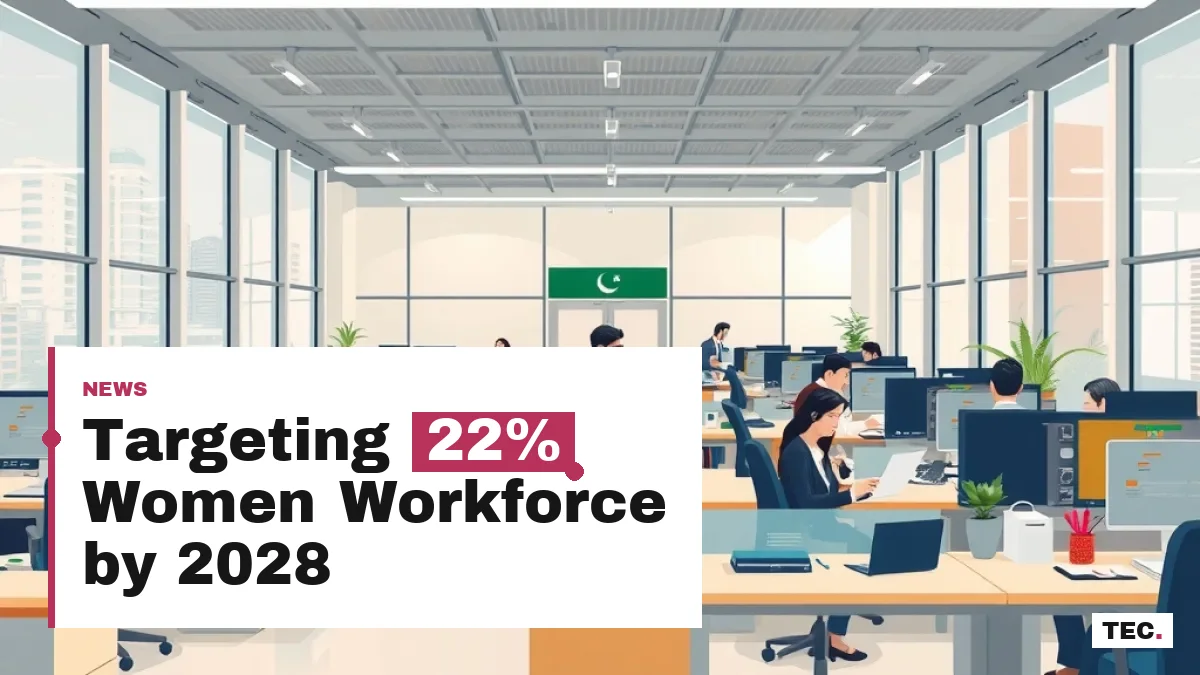
Commercial banks operating in Pakistan must increase female workforce representation from the current 17% to 22% by December 2028. The State Bank of Pakistan issued these binding targets under its Banking on Equality Policy, demanding concrete action plans and clear recruitment timelines from financial institutions across the country.
For female tech professionals, fintech specialists, and business graduates eyeing the banking sector, this policy shift alters hiring trajectories over the coming years. The updated directive builds on prior progress that pushed the sector baseline from 13% in 2021 to 17% in 2025. That four-year increase added roughly 17,500 women, bringing total female bank employment to nearly 50,000 workers across state, private, and foreign commercial institutions.
Action Plans and Recruitment Targets
Central bank rules state that financial institutions cannot rely on passive hiring to hit the 22% quota. Every commercial bank must formulate formal action plans featuring explicit recruitment targets, department-level quotas, and set schedules to scale up female hiring across entry, mid-level, and specialized technical positions.
Institutions must prioritize posting female staff at branches and in urban centers of their personal choice whenever feasible. Geographic assignments often create personal safety and commuting challenges for female workers, so choice of posting addresses a core driver of turnover in retail branch networks.
Management pathways are undergoing mandatory restructuring under the updated framework. Banks must implement merit-based promotion policies specifically designed to pull more women into senior leadership and decision-making roles. Historically, female professionals in the sector have remained concentrated in entry-level administrative jobs despite overall numerical gains in recruitment.
To support this internal career progression, financial institutions must establish structured mentorship, coaching, and skill development programs for female employees. These internal tracks connect with external developmental initiatives, including programs cataloged through the SBP women entrepreneurs competition, designed to expand economic participation among women across commercial sectors.
Financing and Microcredit Deployments
Regulatory mandates extend past corporate human resources into client-facing credit operations and field services. Banks must appoint higher numbers of female financing officers and loan managers, focusing on operational areas with low financial inclusion rates.
- Microfinance and agriculture portfolios targeting rural communities
- Small and medium-sized enterprises run by female business owners
- Housing finance programs and sustainable commercial initiatives
Central bank figures reveal existing momentum across female-focused financial services. Women hold over 78 million bank accounts in Pakistan, with active accounts crossing the 45 million mark. That active account volume represents a 116% increase compared to the baseline established in 2021. Within agricultural finance, roughly 377,000 women secured loans worth Rs. 105 billion, while approximately 2.8 million women accessed microcredit totaling Rs. 152 billion. Additionally, branchless banking agent outlets operated by female agents expanded past 23,000 across urban and rural locations.
Workplace Standards and Compliance
Enforcement of the 22% workforce mandate requires strict adherence to statutory workplace harassment standards across all banking offices. Banks must furnish full maternity, miscarriage, and iddat leave in accordance with national labor laws and central bank operational guidelines.
Institutions must also establish functional daycare facilities on premises or provide direct monetary daycare allowances to support working mothers. This requirement intends to prevent career drop-offs among mid-career female professionals balancing family care responsibilities with full-time corporate duties. The central bank plans to track compliance through regular supervisory audits ahead of the December 2028 deadline.
The original Banking on Equality initiative launched in 2021 helped reduce Pakistan's financial inclusion gender gap from 39% in 2021 down to 29% in 2025. By enforcing higher workforce targets, the central bank aims to embed that inclusion trajectory within the internal management structures of the banking system.
Frequently Asked Questions
What is the new deadline for banks to increase women workforce representation?
Commercial banks operating in Pakistan must reach a 22% women workforce representation by December 2028 under the updated SBP directives.
What was the previous percentage of women in the banking sector?
Women accounted for 17% of the commercial banking workforce in 2025, up from 13% in 2021.
What specific support systems must banks provide for working mothers?
Banks must comply with workplace harassment laws, provide statutory maternity, miscarriage, and iddat leave, and establish functional daycare facilities or provide monthly daycare allowances.
Source: TechJuice