Introduction
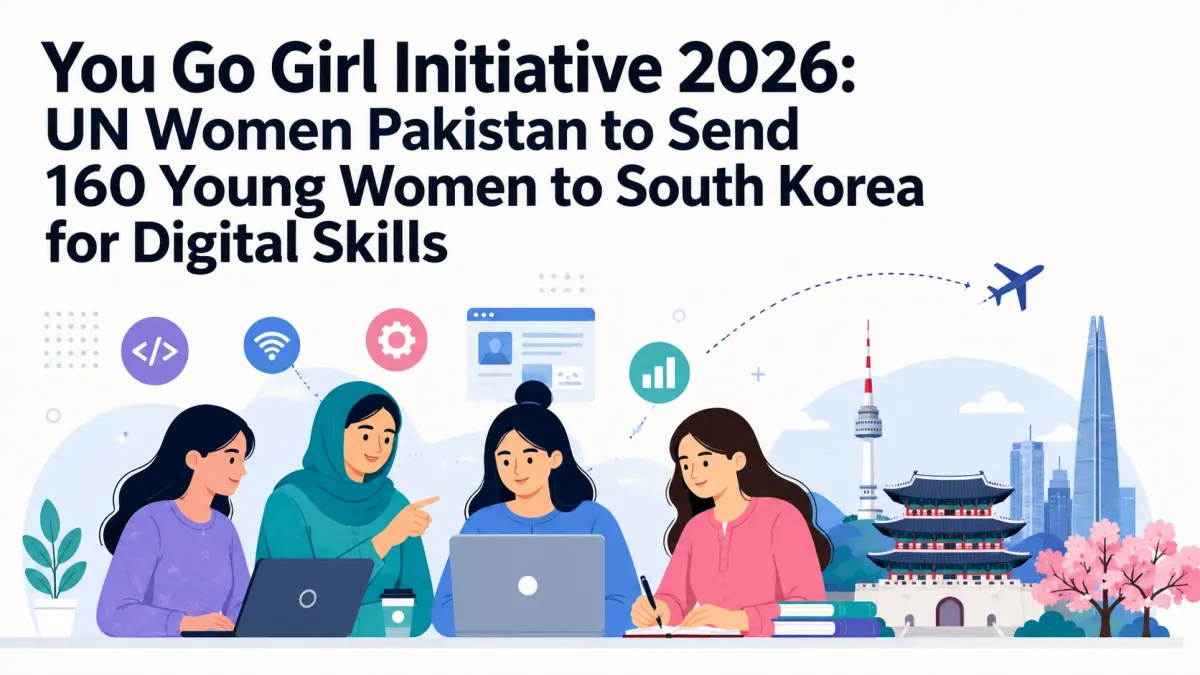
For a young woman in Faisalabad or Peshawar who has taught herself a bit of coding, design, or digital marketing on a patchy internet connection, the idea of flying to South Korea to learn from one of the most advanced tech economies on earth sounds like a dream too big to say out loud. In 2026, UN Women Pakistan is trying to make that dream real for 160 of them.
Under a programme called the "You Go Girl" Initiative, UN Women Pakistan has launched a Call for Proposals to select the organisations that will run a two-year effort to equip young women from Punjab and Khyber Pakhtunkhwa with digital skills, leadership training, mentorship, and — the headline part — international knowledge-exchange visits to the Republic of Korea. The initiative sits under the KOICA-funded Digitalization for Women Economic Empowerment (D4WEE) project.
There's an important nuance most people scrolling past the announcement will miss: this is not a scholarship that individual women apply to directly. It's a call for civil society organisations to design and deliver the programme. But it matters enormously to every young Pakistani woman in tech, because it signals where serious international money is flowing — and it tells you which doors are about to open. Here's the full breakdown.
What Is the "You Go Girl" Initiative?
The You Go Girl Initiative is a capacity-building programme designed to move young Pakistani women into the digital economy and technology sector. Rather than a one-off training, it bundles several things together: digital skills development, leadership and professional networking, structured mentorship, and international exposure through knowledge-exchange visits to South Korea. The programme is scheduled to run across 2026 and 2027.
The goal is straightforward but ambitious — improve women's access to technology-driven careers and leadership opportunities in a country where the digital gender gap remains one of the widest in the region. The "exchange visit" component is what sets it apart from the dozens of local skills bootcamps that already exist. Participants are meant to see, first-hand, how one of Asia's leading tech ecosystems actually works, and to carry those networks and ideas home.
Who's Behind It: UN Women, KOICA, and the D4WEE Project
The initiative is implemented by UN Women Pakistan, the United Nations entity for gender equality and women's empowerment. The money comes through the Korea International Cooperation Agency (KOICA) — South Korea's official development assistance body — which funds the wider Digitalization for Women Economic Empowerment (D4WEE) project that You Go Girl sits inside.
That combination is the reason the Korea link runs so deep. D4WEE is explicitly about closing the digital divide for women, and pairing it with KOICA funding gives UN Women a natural pathway to send participants to Korea for exposure. On the official Call for Proposals, the funding agencies are listed as UN Women (headquarters) and KOICA (headquarters), while the grantmaking entity is UN Women Pakistan — a multilateral organisation. The reference number for the tender is UNW-AP-PAK-CFP-2026-011.
What Participants Will Actually Receive
The core promise to the 160 selected women is a package rather than a single benefit. According to UN Women, the programme is built to enhance participants' digital skills, leadership, professional networks, and economic opportunities through structured exposure, mentorship, and alumni engagement.
The most tangible piece is the international knowledge-exchange visit to South Korea. Based on programme descriptions circulating through development-funding platforms, participant activities are expected to include institutional visits, technology-sector exposure, professional networking, leadership development, mentorship, and cultural exchange. Crucially, the design doesn't end when the women fly home — it includes post-visit alumni engagement, mentoring, digital networking, and knowledge-sharing so that the momentum continues. That "what happens after" element is often where skills programmes quietly fail, so its inclusion here is notable.
Who the 160 Women Are: Participant Eligibility
The programme is aimed at young women from two provinces: Punjab and Khyber Pakhtunkhwa. UN Women confirms the target of 160 participants drawn from these regions. Reporting from development-sector platforms adds that participants are expected to be women aged roughly 18 to 35 — a detail attributed to those secondary summaries rather than stated in UN Women's short public notice, so treat the exact age band as indicative until the full CFP document confirms it.
The focus on Punjab and KP is deliberate. Both provinces have large youth populations and growing but uneven access to digital opportunity, and KP in particular has historically been underserved by tech-empowerment programmes compared to major urban centres like Karachi and Lahore. Channelling international exposure toward women in these regions is a meaningful geographic choice.
Why South Korea? The Pakistan–Korea Digital Angle
The choice of Korea isn't incidental. South Korea runs one of the most digitally advanced economies in the world, with deep strengths in electronics, software, e-commerce, and innovation infrastructure. For a development programme whose entire premise is moving women into the digital economy, Korea is close to an ideal live case study.
There's also a diplomatic and funding logic. KOICA has been steadily expanding its development footprint in Pakistan, and women's digital empowerment is a priority area for Korean aid. Exchange visits build people-to-people ties that outlast any single project — the participants become an informal alumni network with a direct line into Korea's innovation ecosystem. For Pakistan's broader ambition of growing IT exports and a skilled digital workforce, seeding that kind of connection among young women is a quietly strategic move.
The Bigger Picture: Pakistan's Digital Gender Gap
To understand why an initiative like this exists, you have to look at the gap it's trying to close. Pakistan consistently ranks among the countries with the widest gender gaps in mobile ownership, internet access, and digital-skills participation. Women are underrepresented across the tech workforce, from freelancing to formal employment, and the barriers are a mix of access, affordability, safety, mobility, and social norms.
Programmes that combine skills with international exposure attack several of those barriers at once. They don't just teach a woman to code or run a digital campaign — they hand her a credential, a network, and the confidence that comes from having represented her country abroad. In a job market where a freelancer's biggest obstacle is often being taken seriously, that combination can be genuinely career-altering. This is the theory of change You Go Girl is betting on.
Important: This Is a Call for Organisations, Not Individuals
Here is the point that trips up most readers, and it's worth stating plainly: young women cannot apply to the You Go Girl Initiative directly. This Call for Proposals is aimed at civil society organisations. UN Women is looking for a qualified partner to design and deliver the whole programme — recruit the participants, run the training, manage the Korea logistics, and handle safeguarding and follow-up.
So if you're an individual woman hoping to join, the practical path is different. Watch for the organisation that ultimately wins this contract, because once selected, that partner will open the actual recruitment for the 160 participant slots. Following UN Women Pakistan and the eventual implementing partner on social media is the way to catch that participant call when it opens. For now, the opportunity on the table is for organisations.
Who Can Apply: CSO Eligibility and the Consortium Rule
For organisations, the eligibility bar is specific. UN Women is seeking a qualified Pakistan-based civil society organisation (CSO) working in consortium with a Korea-based CSO. That consortium requirement is non-negotiable and central to the whole design — the Korean partner is what makes the in-country exchange visits workable.
In practical terms, that means the lead applicant should be a nationally registered Pakistani CSO with a proven track record in women's empowerment and programme management, formally partnered with a credible Korean counterpart. Organisations that can demonstrate experience running large training programmes, strong logistics and risk-management plans, participant safeguarding, and a serious post-programme engagement strategy will be far more competitive. UN Women development programmes also typically require applicants to have a safeguarding (PSEAH) policy aligned with UN standards.
The Budget: What's on the Table
The financial scale of the programme signals how serious it is. According to development-funding platforms summarising the CFP, the proposal budget should fall between roughly PKR 122,046,120 and PKR 135,606,520 — in other words, north of 120 million rupees for the selected consortium to deliver the full two-year programme for 160 women.
A word of caution on this figure: the budget range is reported by secondary funding-listing sites, not stated in UN Women's brief public notice, so applicants should treat the exact numbers as a guide and verify them against the official CFP document before building their financial proposal. Either way, a budget of this size — covering international travel for 160 participants, training, mentorship, and multi-year engagement — makes this one of the more substantial women's digital-empowerment tenders UN Women Pakistan has issued recently.
Timeline and the Critical Deadline
The clock is the most urgent part of this story. UN Women lists the submission deadline as 13 July 2026. With the tender having gone live in late June, that leaves interested organisations a genuinely tight window to assemble a consortium, secure a Korean partner, and produce a complete technical and financial proposal.
For any Pakistani CSO reading this and thinking about applying, the realistic message is: move now. Building a cross-border consortium and a costed, well-structured proposal in a matter of days is demanding, and incomplete or rushed submissions are exactly what these processes screen out first. The two-year implementation period itself runs across 2026 and 2027 once a partner is selected.
How to Apply and Where to Get the Documents
The full Call for Proposals — including the detailed scope, eligibility criteria, evaluation method, and submission templates — is published on the UN Women Asia-Pacific website under the programme-implementation section, with the reference UNW-AP-PAK-CFP-2026-011. The complete CFP is available there as a downloadable Word document, and organisations should read that primary document in full rather than relying on any summary.
The listed contact for queries is Abira Farooq at UN Women Pakistan, reachable by email at abira.farooq[at]unwomen.org and by phone at 0092-326-8474580. Interested organisations should direct clarification questions there and follow the exact submission instructions in the CFP document, since procurement processes like this one are strict about format and completeness.
What Makes a Strong Proposal (and What Sinks a Weak One)
For CSOs deciding whether to compete, the difference between winning and losing usually comes down to a handful of things. Strong proposals demonstrate real experience in women's empowerment programmes, present a detailed and realistic implementation methodology, and build a genuinely capable partnership with a Korea-based CSO rather than a partner-of-convenience. They also take participant safety, logistics, and risk management seriously, and they spell out concrete mentoring and alumni follow-up activities.
The common mistakes are just as predictable: submitting incomplete technical or financial sections, presenting weak logistics or vague implementation plans, failing to prove organisational capacity, underplaying participant safety and coordination, ignoring post-visit engagement, and pitching budgets that are unrealistic in either direction. In a process this competitive, value for money and sustainability aren't box-ticking phrases — they're often what separates the shortlist from the rejection pile.
What This Means for Pakistan's Women in Tech
Step back from the procurement details and the significance is clear. International donors and the UN are putting serious money behind the specific idea that Pakistani women belong in the digital economy — not just as trainees at home, but as participants with global exposure and networks. That's a signal worth reading.
For students and early-career women in tech, the practical takeaway is to get visible and get ready. The participant call will eventually open through whichever organisation wins this contract, and the women best positioned to be selected will be those already building skills, portfolios, and a presence in Pakistan's tech community. For organisations, funders, and the ecosystem at large, initiatives like You Go Girl are a reminder that gender inclusion in tech has moved from slogan to funded, measurable programming — and that the appetite to invest in it is growing.
Key Details at a Glance and Final Word
To summarise the essentials: the You Go Girl Initiative is a UN Women Pakistan programme funded through KOICA's D4WEE project, aiming to equip 160 young women from Punjab and Khyber Pakhtunkhwa with digital skills, leadership, mentorship, and knowledge-exchange visits to South Korea across 2026–2027. The current opportunity is a Call for Proposals (reference UNW-AP-PAK-CFP-2026-011) inviting a Pakistan-based CSO, in consortium with a Korea-based CSO, to deliver it. The submission deadline is 13 July 2026, and reported budgets sit in the range of roughly PKR 122–135 million.
Whether you're an organisation weighing a bid or a young woman watching for the participant call to open, the underlying message is the same: the opportunity is real, the money is substantial, and the timeline is short. Keep an eye on UN Women Pakistan's channels, and if you know a CSO that fits, point them to the official CFP today — the deadline won't wait.