Pakistan Is Quietly Writing the Rulebook for Its Digital Decade
Every digital payment you make, every government form you submit, every AI model trained in Pakistan, and every fintech app in your pocket runs on one invisible ingredient: data. It has become the country's most strategic resource — and yet, for years, almost no one has been governing it as one.
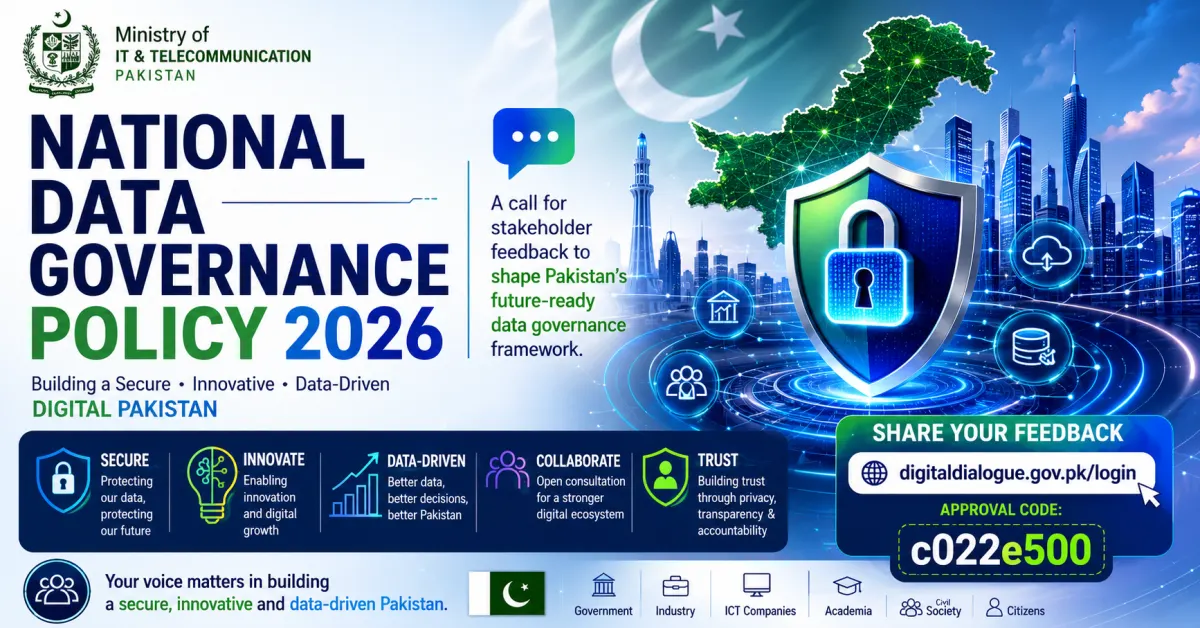
That is about to change. Pakistan's Ministry of Information Technology & Telecommunication (MoITT) has opened a public consultation on the National Data Governance Policy 2026, inviting government institutions, technology companies, startups, academia, researchers, civil society, development partners, and ordinary citizens to help shape the framework. Feedback is being collected through the government's official consultation portal, digitaldialogue.gov.pk.
Unlike earlier technology policies that mostly chased *digitization* — putting forms online, building portals, issuing apps — this one asks a far bigger question: how should Pakistan create, manage, share, protect, and responsibly use data across the entire country? The answer could define the digital economy for the next ten years.
What the National Data Governance Policy 2026 Actually Is
At its core, the policy is a proposed national framework — not yet final law — for how data should be handled across the public and private sectors. MoITT has released a draft for stakeholder feedback rather than imposing rules from the top down.
The consultation deliberately casts a wide net. Input is being solicited from government entities, industry leaders, ICT companies, academia and researchers, technology experts, development partners, civil society organizations, and the general public. That breadth matters: a data framework written only by bureaucrats tends to look elegant on paper and break on contact with reality. Opening it to the people who actually build and use data systems raises the odds that the final version survives implementation.
Data Governance Is Not the Same as Cybersecurity
This is the single most common misconception, so it's worth being blunt: data governance is much bigger than security.
Cybersecurity asks, *"How do we stop intruders?"* Data governance asks a longer list of questions: Who owns this data? Who is allowed to access it? How is it collected, and with whose consent? How is it shared between departments? How long is it stored? How do we keep it accurate? And critically — *who is accountable when something goes wrong?*
Without governance, the symptoms are familiar to every Pakistani: government departments work in silos, citizens submit the same documents over and over, businesses can't access trusted datasets, AI systems produce unreliable results, and privacy risks pile up. Good governance is what turns scattered, messy information into a genuine national asset.
The Numbers: Why the Timing Is No Accident
This policy is not arriving in a vacuum. It lands at the exact moment Pakistan's digital economy is hitting record numbers.
According to the State Bank of Pakistan, IT and IT-enabled services exports crossed $4.19 billion in the first eleven months (July–May) of FY2025-26 — an all-time high, up roughly 20% year-on-year and about $710 million more than the same period a year earlier. Officials project full-year exports could reach $4.5 billion or more by the close of June 2026. The IT sector now accounts for over 40% of Pakistan's total services exports and supports an estimated one million freelancers alongside formal software firms.
Pull the lens back and the trajectory is even more striking. A decade ago, annual IT exports hovered near $2 billion. In December 2025, monthly receipts crossed $400 million for the first time. This is no longer a niche sector — it is becoming a pillar of the national economy. And an economy that runs increasingly on data simply cannot afford to leave that data ungoverned.
What the Policy Is Trying to Achieve
According to MoITT, the framework aims to establish national standards for data governance, data management, secure data sharing, data protection, and responsible utilization. Beyond the technical goals, it targets outcomes that touch everyday life: evidence-based policymaking, innovation, better public service delivery, and a more secure digital ecosystem.
These objectives map directly onto Pakistan's broader Digital Nation agenda and the country's wider digital transformation push — making this policy less of a standalone document and more of a missing connective layer.
The Five Pillars of Modern Data Governance
While the final draft will define implementation details, internationally proven governance models rest on five core pillars:
1. Data Quality. Poor data produces poor decisions. Government databases are riddled with duplicate records, inconsistent formats, and outdated entries. Governance sets standards for accuracy, completeness, consistency, validation, and lifecycle management.
2. Data Security. Government systems now hold citizen identities, financial records, land titles, healthcare data, and tax information. Strong governance introduces encryption, access controls, audit trails, data classification, and incident response.
3. Privacy Protection. The most sensitive pillar. Who owns personal data? Can departments share it? Can private firms monetize it? How is consent obtained, and when must data be deleted? Pakistan is still building toward a comprehensive personal data protection regime — making this the area most in need of clear answers.
4. Secure Data Sharing. Right now, NADRA, FBR, the Passport Office, excise departments, and health and education systems often collect the *same* information independently. A secure national data exchange could slash this duplication while improving service delivery.
5. Accountability. Every dataset needs a designated owner, custodian, quality manager, access policy, and compliance reporting. Without clear ownership, governance is impossible.
How It Connects to the Digital Nation Pakistan Act 2025
The policy doesn't exist on its own. It sits on top of a legal foundation laid in January 2025, when Parliament enacted the Digital Nation Pakistan Act, 2025. That law created three central institutions: the National Digital Commission (NDC), chaired by the Prime Minister; the Pakistan Digital Authority (PDA), a statutory body tasked with building Digital Public Infrastructure (DPI); and an Oversight Committee led by the Minister of IT & Telecom.
The Act defined the building blocks — "Pakistan Stack," "data exchange layer," and "digital identity" — and the machinery has moved fast. NADRA has since issued the Digital Identity Regulations 2025 and National Data Exchange Layer (NDEL) Regulations 2025, part of the World Bank-backed Digital Economy Enhancement Project (DEEP). Digital CNIC credentials, accessible through the PAK ID app, now carry the same legal status as physical cards.
In short: Pakistan built the *rails* in 2025. The National Data Governance Policy 2026 is the attempt to write the *traffic rules* for what runs on them.
The Missing Piece: Personal Data Protection
Here is the honest gap. Analysts have repeatedly pointed out that the Digital Nation Act established powerful data-sharing infrastructure but did not, on its own, set out comprehensive data protection principles or independent oversight. Pakistan still lacks a fully enacted, comprehensive personal data protection law.
A separate Personal Data Protection Bill has been circulating in draft form, but it has drawn criticism — most notably that it would impose obligations on businesses while leaving broad exemptions for state agencies, a structure that diverges from international benchmarks like the EU's GDPR, which applies equal obligations to public and private bodies. This is the context in which the new governance policy will be judged. Build it with strong privacy safeguards and independent oversight, and it becomes a trust engine. Skip those, and it risks becoming infrastructure without guardrails.
Why AI in Pakistan Lives or Dies on Data Governance
Artificial intelligence is only as good as the data behind it — and Pakistan is betting heavily on AI, with a National AI Policy targeting the training of 200,000 people a year and initiatives like Indus AI Week 2026 raising the sector's profile.
But poor governance produces biased models, inaccurate predictions, privacy violations, and security holes. Good governance produces the opposite: trustworthy AI, explainable models, better analytics, and responsible automation. As Pakistan scales AI adoption across health, agriculture, finance, and government, data governance stops being optional housekeeping and becomes the foundation the entire AI ambition stands on.
What It Means for Pakistan's Startups
For founders, this is quietly one of the most important policy developments in years. Reliable national data standards could unlock entire categories of startups — in AI, fintech, healthtech, agritech, govtech, smart logistics, and digital identity services.
The logic is simple. Today, a Pakistani startup that needs verified identity, address, or financial data often has to build fragile workarounds or strike one-off integrations. With standardized national frameworks and a functioning data exchange layer, startups could eventually *plug in* instead of *reinvent* — lowering build costs, shortening time to market, and raising customer trust. Interoperability is not a buzzword here; it is the difference between a startup spending its seed round on plumbing versus product.
Opportunities for Government and Citizens
Done right, the payoff is concrete on both sides of the counter. Citizens could submit information once instead of repeatedly. Reliable national datasets would sharpen policymaking and speed up decisions. Shared, verified records would cut fraud and duplication. Better data standards would raise transparency and accountability. And reduced duplication across departments would lower administrative costs — money that can be redirected to services rather than redundant data entry.
The Hard Problems Pakistan Still Has to Solve
No data governance project is free of difficult trade-offs, and pretending otherwise would be dishonest.
Privacy vs. innovation. Businesses want data; citizens want privacy. Striking that balance is the whole game.
Interoperability. Many government systems were built independently, on different standards, in different eras. Stitching them together demands common standards, APIs, metadata discipline, and shared governance rules.
Institutional readiness. Technology can't fix governance alone. Organizations need trained staff, dedicated governance offices, legal frameworks, and active compliance monitoring.
Public trust. Perhaps the hardest of all. Given the sensitivity around NADRA's biometric database — one of the world's largest centralized identity systems, covering well over 200 million citizens — people will only support national data initiatives if they trust the security, transparency, accountability, and independence of oversight behind them.
Lessons Pakistan Can Borrow — and Adapt
Leading digital economies have shown that successful data governance is about far more than technology. Estonia is famous for interoperable government systems and a "once-only" principle where citizens never submit the same data twice. Singapore has invested in enterprise architecture and trusted digital identity. The United Kingdom has built mature digital governance practice. And the European Union's GDPR remains the global gold standard for privacy, anchored in data minimization and privacy-by-design.
Encouragingly, the Pakistan Digital Authority has said it studied roughly 30 countries — drawing on Estonia and Singapore for architecture, the UAE for citizen experience, and the UK for governance. The opportunity is to *adapt* these models to Pakistan's legal, institutional, and economic context — not to copy-paste foreign frameworks that were never built for a federal country of 240 million.
How to Take Part in the Public Consultation
This is the part most readers will skim — and shouldn't. One of the strongest features of this initiative is that MoITT opened the draft for feedback *before* finalizing it. The consultation welcomes input from government entities, industry leaders, ICT companies, academia, researchers, technology experts, development partners, civil society organizations, and the general public.
If you build with data, secure it, regulate it, or simply care about how your personal information is handled, your voice carries weight here. Feedback can be submitted through the official portal at digitaldialogue.gov.pk. Policies written with practitioners in the room tend to be the ones that actually work — and silence now means someone else decides the rules you'll live under later.
The Verdict: From Digitizing Services to Governing Data
Here's my read. For most of its digital journey, Pakistan focused on *digitizing services* — moving things online — rather than *governing the data itself.* The National Data Governance Policy 2026 signals a genuine shift: treating data as national infrastructure, on par with roads, electricity, and telecom.
But — and this is the whole point — success will depend far less on the policy document and far more on execution. Clear governance structures, consistently enforced standards, real investment in institutional capacity, and hard-won public trust will decide whether this becomes a foundation or a filing cabinet. Equally, the framework has to empower innovation without trampling citizens' rights; lean too far either way and it fails.
Pakistan is standing at a real inflection point. Data is now the fuel powering AI, digital government, fintech, healthcare, and economic growth. Without clear rules on how that data is collected, shared, protected, and used, its full value stays locked away. This policy is the chance to build the foundation — and the choices made during this consultation will echo through Pakistan's digital ecosystem for years.
Article Metadata — Move to CMS Fields, Then Delete This Section
Focus Keyword: National Data Governance Policy 2026
URL Slug: /national-data-governance-policy-2026-pakistan
Category: Policy & Governance
Tags: National Data Governance Policy 2026, Data Governance Pakistan, Digital Pakistan, MoITT, Pakistan Digital Authority, Data Protection Pakistan, AI Pakistan, Digital Nation Pakistan Act, Pakistan IT Exports, NADRA Digital ID
Social Media Summary: Data is now Pakistan's most strategic resource — and the government is finally moving to govern it. MoITT has opened public consultation on the National Data Governance Policy 2026, a framework to manage, share, protect, and responsibly use data across the country. With IT exports hitting a record $4.19 billion and AI adoption accelerating, the timing is no accident. Here's what it means for startups, AI, privacy, and Digital Pakistan — and how to submit your feedback. #DataGovernance #DigitalPakistan #TechSpectrum
Suggested Featured Image Filename: national-data-governance-policy-2026-pakistan.jpg
Image Generation Prompt (1200 x 675 px): A clean, modern editorial illustration on a light off-white background. Center-right: a stylized outline map of Pakistan rendered as a glowing network of connected data nodes and thin teal-and-emerald connection lines, suggesting a national data exchange. Foreground-left: minimalist flat icons representing data governance — a shield with a lock, a database cylinder, a document with a checkmark, and a small group-of-people icon — arranged in a tidy horizontal row. A subtle digital grid and faint circuit lines in the background, kept light and uncluttered. Restrained, professional palette: soft greens, teal accents, dark slate text on a bright background (no dark or neon-heavy theme). Plenty of negative space, crisp vector style, high clarity, no text or words in the image. Aspect ratio 16:9, 1200x675.