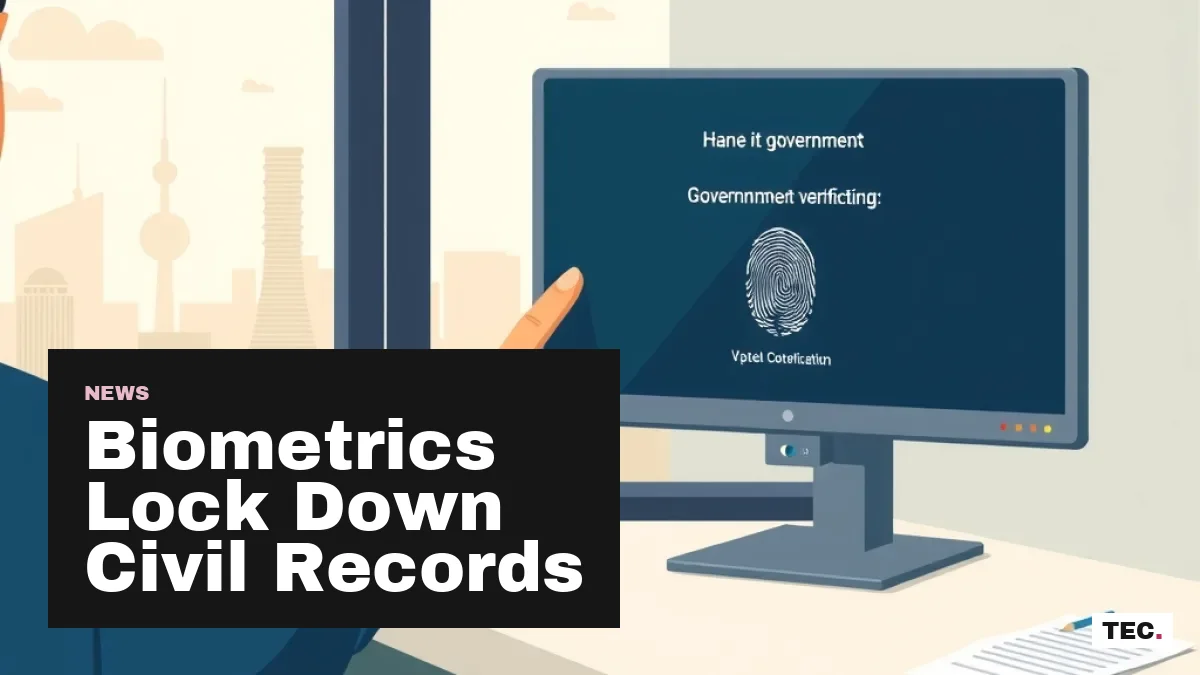
Securing a valid municipal document in Pakistan has long involved navigating layers of bureaucratic inertia, clerical gatekeeping, and paperwork vulnerabilities. The provincial administration is now overhauling that touchpoint: mandatory biometric verification has been launched across union council service desks to validate identity records prior to official document release. For tech practitioners observing Pakistan's civic digitisation drive, this deployment marks a critical transition from paper-heavy local registries to direct, secure synchronisation with national identity databases.
The upgraded infrastructure connects frontline council desks directly to the National Database and Registration Authority (NADRA), establishing real-time citizen validation before certificates are generated. The rollout targets structural inefficiencies across grassroots administration, removing informal middlemen while laying verifiable data rails for downstream civic services.
What Is the Civil Registration Management System?
The Civil Registration Management System (CRMS) serves as the primary software platform handling foundational demographic records at the municipal tier across Punjab. Developed by the provincial Local Government Department in close partnership with NADRA, the upgraded system integrates identity verification at the very instant an application is submitted.
Instead of relying purely on physical forms, witnessed signatures, and manual identity checks by council secretaries, CRMS connects local government workstations directly to NADRA's citizen repository. An applicant must place their finger on a biometric reader, confirming their identity against official state data before any official certificate can be produced or issued.
The system was formally inaugurated by Punjab Local Government Minister Zeeshan Rafique during an official launch at Company Bagh in Sheikhupura. The initiative falls under the provincial government's broader administrative campaign titled "Digital Punjab, Transparent Punjab," aligning with Chief Minister Maryam Nawaz's stated priority of streamlining citizen-facing public services.
Which Civil Records Now Require Biometric Verification?
The updated CRMS protocol applies directly to the primary vital statistic documents issued at the union council tier. Citizens interacting with their local registry offices will encounter mandatory authentication when processing several vital documents:
- Birth certificates: Registering newborns or seeking official birth documentation now requires identity authentication of the applicant directly against national data records.
- Death certificates: Filing for the formal record of a deceased family member demands biological confirmation by the registering kin to close estates accurately and prevent unlawful registrations.
- Marriage certificates: Processing union records requires verified biological authentication to confirm identity details and prevent fraudulent filings.
By securing these three foundational pillars of civil documentation, the provincial government aims to eliminate ghost registrations, inaccurate family tree links, and duplicate entries. This step follows broader national efforts to digitise civic touchpoints, much like when the federal authority launched a dedicated NADRA mobile app for birth, marriage, and death registration to process demographic records digitally.
How Does the Biometric Protocol Work at the Desk?
The practical workflow for citizens visiting a union council office under the new CRMS framework replaces manual discretion with an automated identity handshake:
- Application submission: The applicant approaches the local union council office with the necessary particulars for a birth, marriage, or death event.
- Biometric scanning: The individual places their thumb or finger on an integrated optical scanner connected to the CRMS terminal.
- Real-time NADRA verification: The system transmits the captured biometric print to NADRA's central records to confirm that the person submitting the claim matches their official identity record.
- System-cleared certificate issuance: Once the automated authentication returns a successful match, the council operator can complete the registration workflow and print the verified certificate.
Local Government Minister Zeeshan Rafique explained during the ceremony that this verified loop ensures that residents can access authentic municipal records without having to seek political recommendations or pay illicit speed money to informal facilitators. The automated authentication effectively neutralises unauthorised tampering with local civil books.
Where Is CRMS Being Deployed Across Punjab?
The deployment commenced in the Sheikhupura district during the initial launch, where local officials, administration staff, and citizens gathered at Company Bagh. Attendees at the inauguration included Member of the Punjab Assembly Pir Ashraf Rasool, Local Government Director General Benish Fatima, a NADRA director general, and Sheikhupura Deputy Commissioner Rana Adeel Taswar.
Rather than attempting a simultaneous overnight rollout across thousands of local councils, the provincial authority confirmed that CRMS biometric integration will expand across all union councils in Punjab in progressive phases. This phased model allows technical teams to test hardware reliability, evaluate connectivity stability at outlying union offices, and train council staff to manage the new terminals smoothly.
Similar cross-agency authentication initiatives have emerged across other provinces as well. For example, neighboring regions have explored verified credentials to combat paper forgery, such as when Sindh integrated its education boards with NADRA to wipe out fraudulent academic records. Strengthening local registry verification in Punjab mirrors this regional turn toward verifiable identity rails.
What Does Verified Civil Data Mean for the Tech Ecosystem?
While CRMS is managed as an administrative reform, the broader implications directly intersect with Pakistan's digital economy, fintech adoption, and public data architecture. Reliable foundational registries serve as the bedrock for modern digital infrastructure.
For local startups, digital banking platforms, and microfinance providers, customer onboarding relies fundamentally on identity assurance. When local government records such as marriage documentation and birth records carry indisputable biometric integrity, secondary documentation disputes decrease significantly. Clean demographic data at the grassroots tier simplifies legal identity verification, reduces fraud risks in succession cases, and creates a more dependable operating environment for services handling digital contracts, inheritance, and asset transfers.
Moreover, linking local council counters to NADRA's central identity repository reinforces a unified digital governance framework. As seen with remote services where NADRA enables CNIC photo and address updates via its PakID app, pushing digital verification tools deeper into the public sector creates a consistent user experience for citizens transitioning between mobile apps and physical government counters.
Questions Citizens and Founders Are Asking
Can someone else collect a certificate on behalf of an applicant?
Under the new protocol outlined by the Local Government Department, certificate issuance requires biometric verification against NADRA records at the processing terminal. The individual registered as the applicant must undergo verification to prevent unauthorised parties from securing fraudulent documentation.
Will rural union councils have the technical infrastructure for this rollout?
The Punjab government is expanding the system to all union councils in planned phases specifically to account for infrastructure readiness. Each participating council office must be equipped with compatible CRMS workstations, secure data connectivity, and calibrated biometric scanners before the verification requirement is activated locally.
Does the biometric check apply to older, existing certificates?
The announced mandate targets new registrations and the issuance of certificates processed through the updated CRMS terminals. Existing, officially verified certificates previously issued remain valid, though any new application for re-issuance or fresh entry through the system must comply with the live biometric workflow.
For further administrative details and updates on the provincial rollout, readers can review the initial coverage provided by TechJuice.
Source: TechJuice