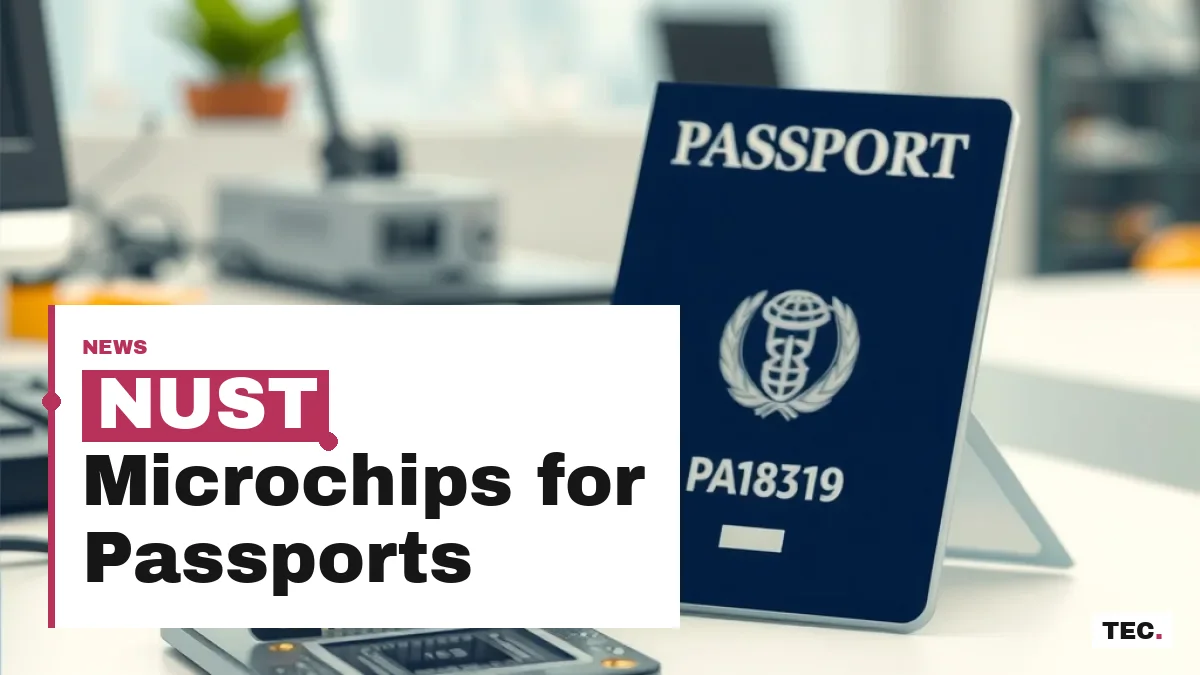
Pakistan is examining the use of local microchip technology in its national passport system to protect citizen personal data and curb foreign supply chain dependencies. The Directorate General of Immigration and Passports recently convened with an engineering delegation from the National University of Sciences and Technology (NUST) to review domestic research into integrated circuits and their potential deployment in secure travel identity documents.
The talks signal an initial push to connect academic hardware research directly with state administrative infrastructure. As the state moves toward full digitization of civic credentials, relying entirely on imported cryptographic chips poses persistent concerns regarding foreign technical dependencies and long-term data security.
Inside the Passports Directorate and NUST Technical Dialogue
Director General of Immigration and Passports Muhammad Ali Randhawa met with researchers and representatives from NUST to inspect ongoing university projects focused on microchip design and hardware architecture. The NUST team presented work on locally developed microchip technology, focusing specifically on how domestic circuits can protect sensitive identity data.
Randhawa endorsed NUST's ongoing research initiatives and pointed out that securing passport databases and issuance pipelines demands modern, locally developed technology. While imported silicon powers biometric passports globally, domestic oversight over chip architecture eliminates hidden vulnerabilities, backdoors, or unexpected supply cuts from foreign vendors.
The discussion remained focused on research alignment. Both sides evaluated how domestic technical capabilities could fit into the state's broader modernization agenda for travel documents, linking university laboratories directly with national identity agencies.
Hardware Sovereignty and National Data Protection
Biometric e-passports contain embedded microcontrollers that store facial images, fingerprint files, and cryptographic signatures verified by international border agencies. Entrusting those credentials entirely to foreign-designed and foreign-manufactured microcontrollers creates systemic exposures. Developing national hardware competencies creates an added protective layer for citizen identity assets.
This initiative aligns with broader institutional efforts to establish sovereign standards for identity systems and government repositories, such as the principles outlined in the National Data Governance Policy 2026: Pakistan's Blueprint for a Secure, AI-Ready Digital Economy. Ensuring that the physical silicon carrying national data is transparent to local engineers prevents covert extraction and hardens digital infrastructure against unauthorized tampering.
Reducing reliance on foreign suppliers also protects passport issuance continuity. Global semiconductor shortages and diplomatic shifts have repeatedly shown that countries without domestic hardware strategies face delayed rollouts and unexpected price shocks whenever international supply lines freeze.
Building Domestic Capacity Across the Silicon Pipeline
Pakistan currently lacks high-end semiconductor fabrication plants, which means true hardware self-sufficiency requires a phased approach focused initially on design, logic synthesis, and cryptographic verification. Pakistani engineering faculties like NUST possess specialized talent in electronic engineering and integrated circuit architecture, but that work has rarely fed into public sector procurement.
Transitioning from pure academic papers to functional, deployable hardware requires structural cooperation across several technical domains:
- Architecture and design of secure microcontrollers equipped with dedicated cryptographic engines.
- Knowledge sharing between university laboratories and state identity systems administrators.
- Verification procedures that test silicon against international civil aviation identity guidelines.
- Packaging, embedded antenna integration, and passport booklet assembly.
- Institutional cooperation models that convert academic research into repeatable public sector production.
By reviewing these steps with university researchers, the Directorate General of Immigration and Passports is taking the first steps to build an indigenous supply channel that values local engineering outputs over off-the-shelf imports.
Upgrading Passport Operations Alongside Local Engineering
The dialogue on domestic silicon arrives during a wider overhaul of Pakistan's travel document operations. The federal government has already committed to phasing out older identity formats, as documented in Pakistan to End Machine-Readable Passports and Shift Fully to E-Passports.
To handle existing operational bottlenecks and clear backlogs across issuance offices, the department has steadily reinforced its physical hardware stack. Earlier infrastructural improvements, including steps where Pakistan Enhances Passport System with High-Speed Printers, expanded the daily document throughput. However, faster mechanical printing addresses only one end of the problem: document production is limited if secure blank chips remain tied to foreign manufacturing allocations.
Integrating locally developed microchip technology into that production line would complete the transformation, shifting the passport network from an operational consumer of imported goods to a platform that stimulates domestic technical capacity.
Structuring the Upcoming Directorate and NUST Memorandum
To move these discussions from an informal briefing into an operational structure, both parties evaluated the terms of an upcoming Memorandum of Understanding (MoU). The envisioned framework aims to establish institutional collaboration between the Passports Directorate and NUST, allowing both organizations to conduct joint research on document security and data protection.
The formal agreement will focus on technical knowledge exchange, structured feedback loops for prototype evaluation, and shared technical roadmaps. Rather than buying commercial systems as a black box, passport authorities will gain direct visibility into the hardware's internal design, while academic researchers gain access to real-world deployment challenges.
A formal MoU also gives university engineers an institutional buyer for their intellectual property, offering a clear path for students and researchers to see their designs used in national applications rather than remaining restricted to academic journals.
Key Questions on Pakistan's Microchip Transition
Will Pakistani passports feature locally made microchips immediately?
No immediate rollout will take place. The Directorate General of Immigration and Passports confirmed that current discussions with NUST remain strictly at the research and exploratory stage. The government has not published a deployment timeline or a formal implementation plan.
Why is local chip development important for citizen travel documents?
Biometric passports hold sensitive cryptographic keys and personal credentials. Using locally developed technology reduces vulnerability to foreign supply disruptions, cuts foreign exchange expenses, and ensures that the hardware safeguarding national identity documents remains subject to domestic verification.
What is the next operational milestone for this partnership?
The next concrete step discussed by both sides is the signing of a Memorandum of Understanding between NUST and the Directorate General of Immigration and Passports to establish a formal framework for technical collaboration and joint research projects.
Source: PhoneWorld