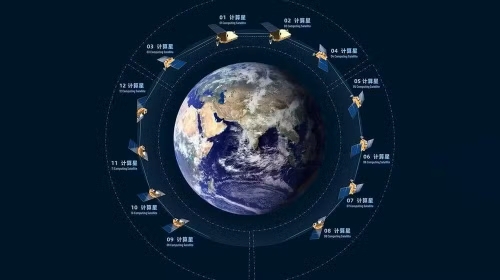
In a monumental step toward redefining global supercomputing, China has launched the first 12 satellites of a planned 2,800-satellite AI constellation, marking the world’s first space-based artificial intelligence supercomputer.
The ambitious project, led by ADA Space in collaboration with Zhijiang Laboratory and Neijang High-Tech Zone, aims to transform outer space into a high-performance computing environment, fundamentally shifting how and where AI processes big data.
AI That Thinks in Orbit
What sets this system apart? Unlike traditional satellites that merely collect and transmit data back to Earth for processing, these satellites analyze data on their own—right in orbit.
Each satellite is powered by an 8-billion parameter AI model with a compute capacity of 744 tera operations per second (TOPS). Together, the 12 satellites already deliver 5 peta operations per second (POPS)—and that’s just the beginning.
Ultimate Goal:
By deploying 2,800 satellites, China plans to build a space-based AI system capable of 1,000 POPS, dwarfing the compute power of many Earth-bound data centers.
Interlinked by Laser, Built for Speed
To ensure rapid, seamless collaboration between nodes, each satellite is equipped with:
- Laser Interlinks with speeds of up to 100 Gbps
- 30 terabytes of distributed onboard storage
- A cooperative processing network that minimizes reliance on Earth-based infrastructure
The result? Low-latency, high-throughput AI computing in space—no cables, no cooling fans, no carbon footprint.
Scientific and Practical Applications
Beyond just AI hype, these satellites carry real scientific muscle:
- X-ray polarization detectors to study high-energy cosmic events like gamma-ray bursts
- 3D digital twin modeling to support applications such as:
- Disaster monitoring
- Urban planning
- Virtual tourism
- Real-time interactive media
By analyzing data in space before transmission, these satellites solve a major bottleneck: less than 10% of raw satellite data ever makes it back to Earth, due to bandwidth limits. Onboard AI cuts the noise and boosts decision-making speeds.
A Cleaner, Smarter Computing Future
According to Harvard astronomer Jonathan McDowell, orbital supercomputers offer key environmental and strategic benefits:
- Solar-powered and naturally cooled, reducing the carbon footprint of AI workloads
- No need for massive land-based data centers, freeing up energy grids and real estate
- 24/7 global coverage, ideal for intelligence, navigation, and disaster response
“This is a practical, scalable model,” McDowell noted, adding that the U.S. and Europe may soon pursue similar projects to keep pace.
Global Implications: The Space Race Just Got Smarter
As China accelerates toward AI dominance in orbit, the implications go far beyond space:
- National security
- Next-gen cloud services
- Real-time Earth observation
- International competitiveness in AI infrastructure
Whether it’s for science or strategy, China’s AI-in-space mission is setting a new standard in the fusion of satellite technology and machine learning.
Final Thoughts
This launch isn’t just about satellites—it’s about shifting the future of computing itself off-planet. With onboard intelligence, laser interconnectivity, and scalable architecture, China is leading the race to build the world’s first orbital AI supercomputer.
The AI revolution is no longer just on Earth—it’s in orbit.