
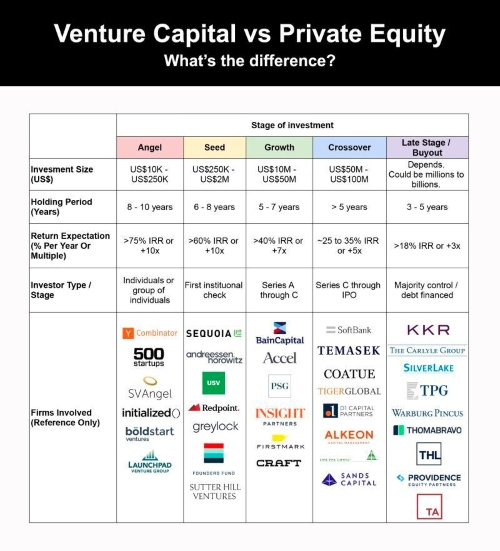
Startups raise funds in distinct stages—each attracting different types of investors. From early ideation to late-stage expansion, understanding the Private Equity (PE) vs. Venture Capital (VC) dynamic is key to fundraising success.
Here’s a breakdown of the five primary startup funding phases:
1️⃣ Angel Stage (Pre-VC)
- Focus: Concept & Vision
- Investor Type: Angel Investors
- Funding Size: $10K – $250K
- Purpose: Seed ideas, build MVPs
- Examples: YCombinator, SVAngel, Initialized
2️⃣ Seed Stage (VC)
- Focus: Product Validation
- Investor Type: Venture Capital
- Funding Size: $250K – $2M
- Purpose: Team hiring, early traction
- Examples: Seed, Redpoint, Greylock
3️⃣ Growth Stage (VC/PE)
- Focus: Scaling Operations
- Investor Type: VC or PE
- Funding Size: $10M – $50M
- Purpose: Market expansion, user growth
- Examples: Bain Capital, Accel, PSG
4️⃣ Crossover Stage (PE)
- Focus: Profitability & Sustainability
- Investor Type: Private Equity
- Funding Size: $50M – $100M
- Purpose: Operational efficiency, M&A readiness
- Examples: Alkeon, SoftBank, Sands Capital
5️⃣ Late Stage / Buyout (PE)
- Focus: Exit Strategy
- Investor Type: Private Equity
- Funding Size: $100M+
- Purpose: IPO preparation or acquisition
- Examples: Silver Lake, Thoma Bravo, The Carlyle Group
🧠 TL;DR – Key Differences Between VC and PE
| Feature | Venture Capital (VC) | Private Equity (PE) |
|---|---|---|
| Typical Investment | Up to $10M | $50M and above |
| Stake Acquired | Minority | Majority/Controlling |
| Company Stage | Early-stage/startups | Mature/profitable businesses |
| Exit Focus | Growth, Series rounds | Buyout, IPO, M&A |
Conclusion:
While VCs fuel innovation at early stages, PEs focus on optimizing mature businesses for long-term returns. Knowing where your startup fits in this journey can help you target the right investors at the right time.
Visited 276 times, 1 visit(s) today