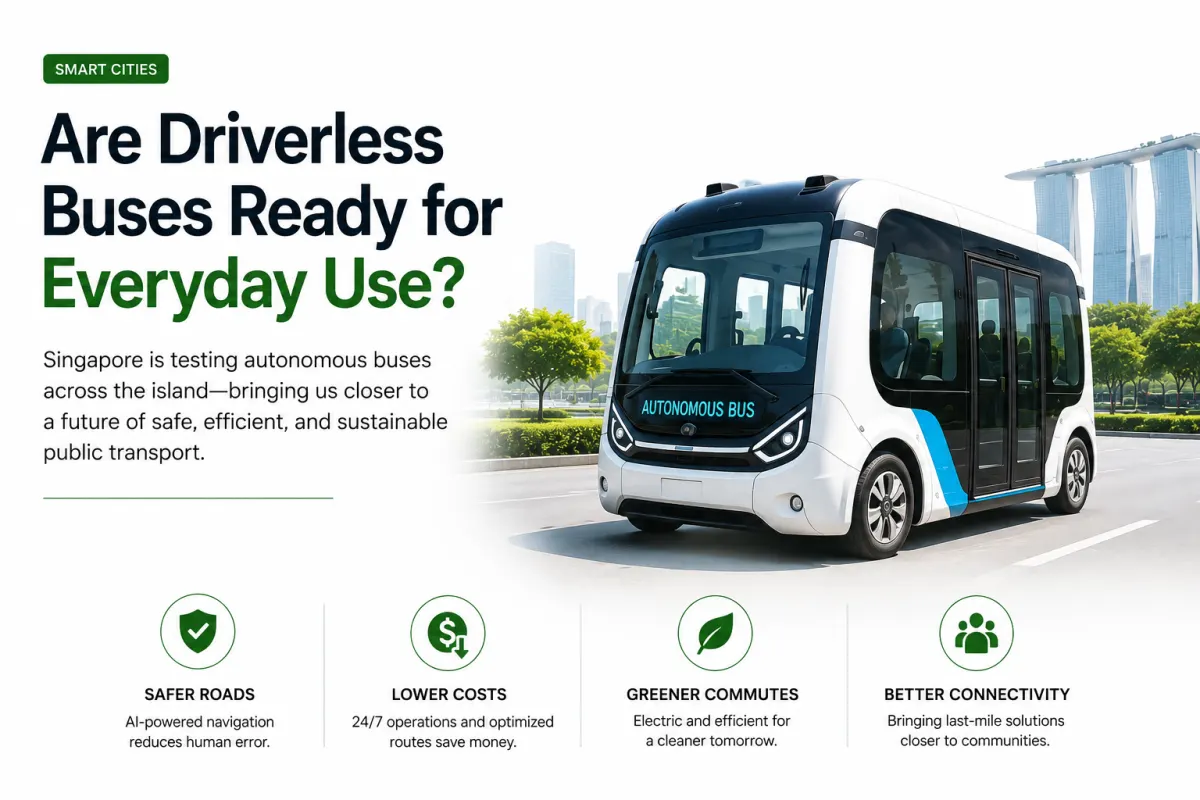
Driverless public transport just took its most concrete step yet toward everyday use. Singapore's Land Transport Authority (LTA) has received the first of six fully autonomous buses, which will begin testing on public routes Service 400 (Marina Bay) and Service 191 (one-north) as part of a three-year pilot program.
The buses are jointly produced by BYD, along with technology firms MKX Technologies and Zhidao Network Technology. Each vehicle seats 16 passengers and includes dedicated space for wheelchair users, with cameras and sensors mounted on the front, rear, and roof providing a 360-degree view of surrounding traffic and pedestrians.
What Happens Next
According to the LTA, the autonomous buses will undergo rigorous testing to confirm they meet safety and operating requirements before being deployed on live routes carrying passengers. Singapore's trial is one of several driverless bus programs advancing globally in 2026, including a pilot under Germany's MAN MINGA (Munich's Automated Local Transport) project, which is testing autonomous buses in real traffic with a safety driver still on board.
Why This Matters for Public Transport
Public transit systems worldwide are under pressure to cut costs, improve service reliability, and reduce emissions — and autonomous buses are being positioned as a practical answer to all three:
- Safer roads — AI-assisted navigation reduces the risk of human error.
- Lower costs — 24/7 operation and optimized routing can cut operating expenses.
- Greener commutes — electric drivetrains support cleaner, more sustainable transit.
- Better connectivity — autonomous shuttles can extend last-mile coverage to underserved areas.
The Challenges Still Ahead
Despite the progress, fully driverless buses still face real hurdles before they can scale beyond pilot programs: regulatory approval, public trust, and the infrastructure upgrades needed to safely mix autonomous vehicles with regular traffic and pedestrians. Singapore's phased, multi-year approach — testing with oversight before any wider rollout — reflects just how methodically transit authorities are moving.
Key Takeaways
- Singapore's LTA has begun testing 6 fully autonomous buses on real public routes.
- The buses are built by BYD, MKX Technologies, and Zhidao Network Technology.
- Each bus seats 16 passengers and is wheelchair-accessible.
- The trial is part of a three-year pilot program on Marina Bay and one-north routes.
- Germany's MAN MINGA project is running a parallel driverless bus trial with a safety driver.
FAQ
Are driverless buses safe?
Singapore's LTA says the autonomous buses will undergo rigorous testing against strict safety and operating requirements before carrying passengers on live routes.
When will driverless buses become common?
Adoption is expected to be gradual — Singapore's own trial is a multi-year pilot, and similar programs like Germany's MAN MINGA still operate with a safety driver on board.