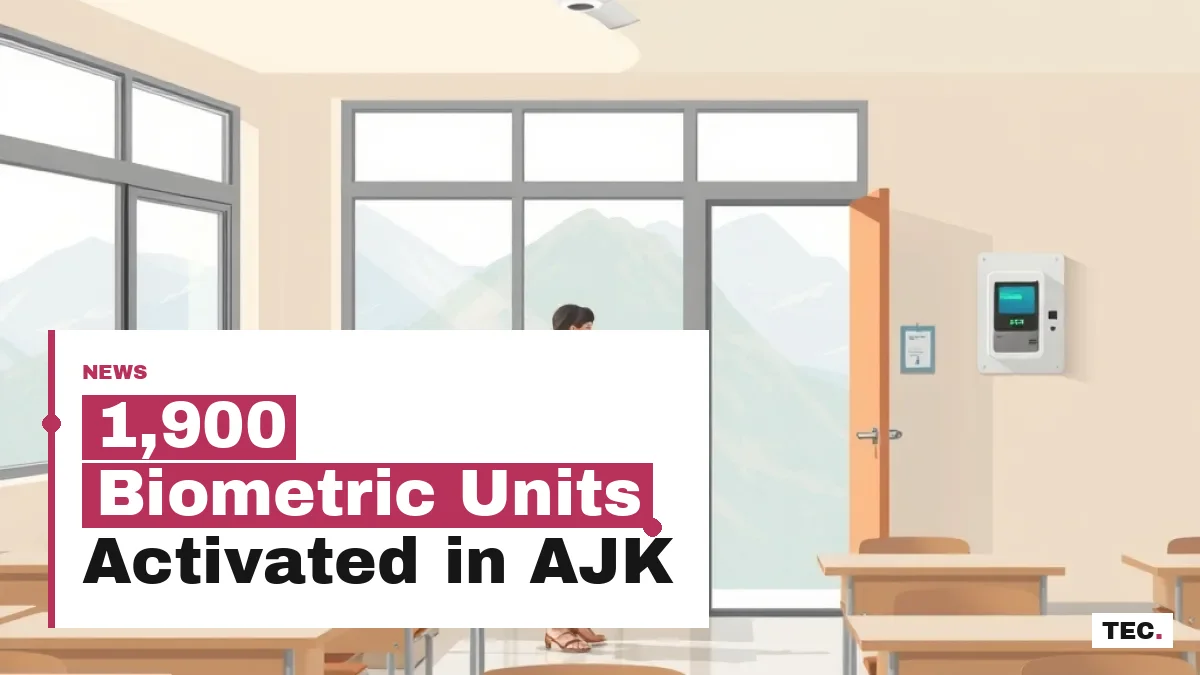
Azad Jammu and Kashmir is rolling out a digital attendance system across its public school network to tackle staff absenteeism and rebuild administrative accountability. Chaired by Minister for Elementary and Secondary Education Engineer Umair Naeem Advocate, a high-level departmental meeting finalised plans to put tracking software into classrooms and fill hundreds of vacant academic roles. For citizens and technology observers tracking public-sector modernisation, the decision addresses one of the most stubborn friction points in regional state schooling: verifying that appointed educators are in classrooms teaching students.
The policy combines mobile software deployment with a cleanup of existing departmental hardware. Rather than relying on paper registers prone to proxy entries, the regional administration is leaning on its Education Management Information System (EMIS) branch to drive daily digital logging from primary schools up to higher secondary levels.
Six Directives Shaping the AJK Education Tech Overhaul
The ministry's reform roadmap sets exact operating targets for field officers, software units, and recruitment boards. A quick breakdown of the six core directives shows how the regional government intends to execute the transition:
- Seven-day deadline for biometric devices: Departmental teams must bring all 1,900 previously installed biometric attendance units back into fully operational status within one week.
- Immediate primary school software rollout: The EMIS attendance application must be deployed across 50 primary institutions in every administrative district within 15 days.
- Secondary deployment wave: Another 200 institutions must receive the attendance software platform without delay to widen institutional coverage.
- March 2027 whole-territory mandate: Every educational institution throughout Azad Jammu and Kashmir must run on the digital tracking system before the end of the first quarter of 2027.
- Accelerated hiring pipeline: Quotas and vacancies for headmasters, computer instructors, science teachers, senior general line educators, and subject specialists must be submitted to the Public Service Commission.
- Inquiry into secondary exam outcomes: A dedicated committee must deliver immediate findings on poor Class IX examination performances recorded during the previous academic session.
Restoring 1,900 Biometric Hardware Terminals
The most immediate operational hurdle is fixing hardware that was purchased, mounted, and then left idle. The education department has directed technical staff to restore 1,900 dormant biometric attendance devices within seven days. Public infrastructure initiatives in Pakistan frequently stumble when standalone biometric terminals suffer from loose wiring, depleted battery backups, or lost connectivity. In nearby jurisdictions, provincial departments have taken hard stances on hardware logs; for instance, authorities took disciplinary action when Balochistan dismissed 72 doctors using AI attendance tracking after digital rosters revealed prolonged unexcused absences.
AJK is attempting to bypass typical public-sector inertia by holding divisional engineers directly responsible for terminal uptime. The minister instructed teams to ensure devices communicate their presence records to departmental servers without offline delays. If this initial hardware restoration succeeds within the seven-day window, it creates an immediate baseline for auditing school-level staffing numbers.
EMIS Application Deployment in District Primary Schools
Alongside fixed biometric terminals, the regional administration is shifting day-to-day data collection to the Education Management Information System (EMIS). Technicians have 15 days to install the proprietary attendance software in 50 primary schools per district. Running an app-based model allows field administrators to log attendance on mobile devices, helping rural schools that lack the steady grid connections required by wall-mounted biometric machines.
Deploying software directly to primary schools mirrors larger regional automation efforts. Similar models have been tried across the border in Punjab, where the Punjab government launched a school monitoring app to digitally audit 60,000 schools and track facility conditions alongside teacher rosters. In AJK, an additional 200 institutions will receive the software package immediately after the primary school pilot, building out a regional footprint that targets total coverage by March 2027.
Opening Recruitment Channels for Computer Instructors and Subject Specialists
Staff tracking solves only half the structural deficit if classrooms sit empty due to hiring freezes. The ministerial review concentrated heavily on identifying vacancies for headmasters, senior general line teachers, science educators, computer instructors, and subject specialists. Field units have received instructions to document unfilled quotas under both departmental and open-merit categories before handing the files to the Public Service Commission.
The focus on hiring computer instructors aligns with regional goals to build foundational digital skills among students. Educational institutions in Muzaffarabad and surrounding districts have increasingly felt the need for technical instructors as regional tech hubs expand, a pattern visible since Pakistan inaugurated its first women's software technology park in Muzaffarabad to support local graduates. Faster public recruitment gives state institutions the capacity to deliver computer science syllabi that otherwise remain unstaffed.
Holding Schools Accountable for Examination Failures
Hardware audits and hiring quotas occurred against a backdrop of declining academic performance. Minister Umair Naeem Advocate highlighted serious worries over Class IX examination metrics from the prior academic cycle. A formal inquiry committee formed to investigate those poor outcomes has been told to table its recommendations without further postponement.
Combining attendance tracking with examination reviews shows an administrative attempt to link teacher presence directly to student marks. While earlier departmental policies treated student evaluations and administrative operations as separate matters, the Friday meeting explicitly linked staff absenteeism to the Class IX pass rates. Detailed coverage of the ministerial session was first reported by TechJuice following official statements from the Elementary and Secondary Education Department.
Questions Surrounding the School Digitisation Drive
How will the attendance system function in remote schools without internet?
The EMIS application is designed for district-level field operations. In areas where continuous cellular coverage is unstable, such platforms typically cache attendance logs locally on mobile devices and sync records once the handset reaches a data connection.
What roles are being referred to the Public Service Commission?
Positions headed for recruitment include headmasters, computer instructors, science teachers, subject specialists, and senior general line educators. Departmental quotas will be settled under existing administrative regulations alongside open testing.
When will all AJK educational institutions be covered?
The Elementary and Secondary Education Department has set March 2027 as the completion deadline for the complete digital attendance system rollout across every educational facility in the territory.
Source: TechJuice