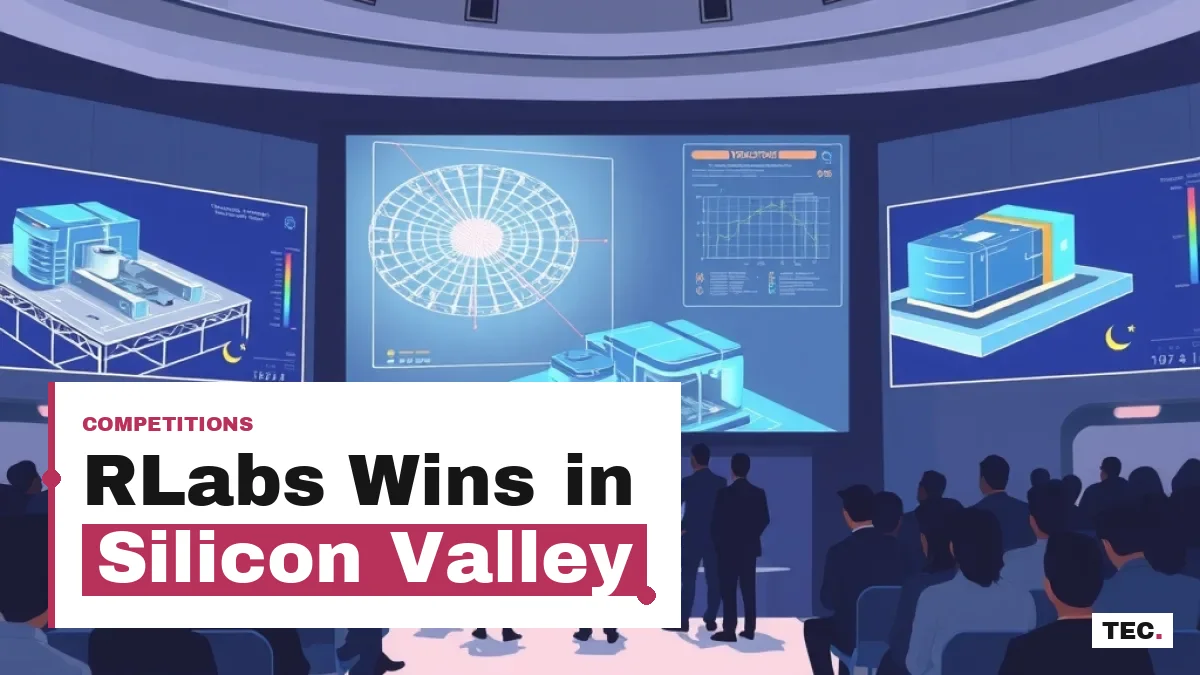
When Islamabad-based deep-tech venture RLabs took the stage in California, it was competing directly against companies from around the world for industrial software validation. Pakistani AI startup RLabs emerged as the winner of the Global Overseas Acceleration & Learning (GOAL) Startup Award at the Silicon Valley November Summit, organised by early-stage investor and corporate innovation platform Plug and Play. The event, which drew more than 3,000 entrepreneurs, venture investors, and enterprise executives, placed Pakistan's engineering talent in front of an international audience that rarely associates the country with proprietary simulation engines.
The company, headed by National University of Sciences and Technology (NUST) graduate Harris Ahmed, uses artificial intelligence and extended reality (XR) to build synthetic training environments for workers and heavy equipment. Rather than operating as an offshore development agency, the venture builds proprietary models designed to accelerate industrial machine learning. The Silicon Valley win comes at a critical juncture: RLabs is now preparing to establish operations in the United States, testing whether industrial software developed inside Pakistani incubation centres can win contracts from North American corporate clients.
How RLabs Cut Simulation Build Times by 75 Percent
Industrial machinery training has historically depended on custom-coded physical simulators or direct on-site equipment access, both of which require heavy capital outlays and months of engineering time. RLabs approaches the problem by combining XR simulators with synthetic data pipelines and machine training platforms. The system trains both human technicians and autonomous machine systems to operate complex hardware inside controlled virtual environments.
According to the National Incubation Centre for Aerospace Technologies (NICAT), where the company was incubated, RLabs is currently developing its own proprietary large language model (LLM). This model powers a modular simulation engine that runs across different computing platforms. By automating the generation of virtual environments, the technology targets a reduction in simulation development timelines of up to 75 percent.
The platform builds virtual setups for multiple operational sectors:
- Specialized factory floor assembly setups
- Defence training applications
- Aviation hardware and operational systems
In practice, training setups that previously took months to assemble for complex environments can be stood up in weeks. Founder Harris Ahmed graduated from NUST in 2018 with a background in computer graphics and virtual reality development. Over nearly ten years working in XR technologies, Ahmed focused on how human operators interact with complex hardware. RLabs transfers those human training datasets into algorithmic models that train artificial intelligence systems, connecting physical human expertise directly with automated machine training. Ahmed completed executive training programmes at Draper University and the University of London before building the startup's current stack.
Plug and Play Summit and the Push Toward American Customers
The Silicon Valley November Summit was the capstone for Plug and Play’s GOAL programme, an initiative created to give foreign ventures direct exposure to American capital and corporate partners. RLabs was one of only 18 startups selected internationally to pitch at the summit. The cohort gained access to enterprise buyers seeking artificial intelligence and synthetic data infrastructure.
Cross-border acceleration programs have increasingly become a primary route for local founders looking to bypass domestic revenue caps. Similar pipelines were visible when 5 NIC Lahore AI startups headed to Plug and Play Silicon Valley to build enterprise pipelines. For RLabs, the Silicon Valley presence is not purely ceremonial; the company announced that it is actively preparing to enter the US market to sell its simulation software directly to American enterprise users.
Entering the North American market forces deep-tech companies to deal with strict enterprise procurement guidelines, local corporate incorporation, and direct competition from well-funded American simulation startups. However, industrial simulation tools have broader export potential than domestic consumer apps, as synthetic data generation remains a high-demand layer for companies deploying autonomous physical machines.
Aerospace Incubation and Public Innovation Backing
RLabs developed its core technology within NICAT, an incubator focused specifically on aerospace and high-complexity technologies in Pakistan. The facility operates under the network supported by Ignite, the federal government's technology innovation fund under the Ministry of Information Technology and Telecommunication (MoITT).
Federal Minister for IT and Telecommunication Shaza Fatima Khawaja congratulated Ahmed and his engineering team following the award. She noted that the win showed the capacity of local tech talent to develop solutions for global markets. State officials continue to point to specialized centres as evidence that domestic infrastructure can nurture advanced hardware and software ventures, a pattern previously noted when Ignite National Incubation Centers won the Commonwealth Digital Excellence Award in London.
The government is currently trying to centralize physical facilities through developments such as the newly inaugurated National Technology Park in Islamabad. That complex intends to co-locate startup teams, established technology businesses, and research laboratories to encourage technical collaboration. Whether these facilities can provide the specialized compute access required for heavy LLM training remains an ongoing operational challenge for the ministry.
The Venture Funding Gap and the World Bank Pipeline
While international demo days and awards generate visibility, Pakistani deep-tech founders face persistent constraints in accessing domestic growth equity. Training large language models and building modular simulation engines require substantial capital reserves, graphic processing units (GPUs), and high-bandwidth infrastructure. Most seed capital inside Pakistan has historically flowed toward fintech and e-commerce aggregators rather than engineering-heavy research and development ventures.
According to project reports cited by PhoneWorld, the World Bank is currently considering a proposed project that includes a $50 million Fund of Funds structured to stimulate venture capital investment across Pakistan. That multilateral proposal, however, is not scheduled for formal approval consideration until early 2027. This multi-year waiting period leaves early-stage deep-tech companies reliant on international angel networks, self-funding, or offshore accelerator programs to bridge the gap.
For RLabs, winning an award among 18 cross-border startups provides useful third-party validation when approaching foreign funds. Yet founders operating in Pakistan must often relocate holding companies abroad to secure investment rounds, especially when preparing to deploy software inside Western regulatory jurisdictions.
What the RLabs Milestone Means for Local Technical Founders
Can Pakistani deep-tech startups build proprietary AI without offshore compute?
RLabs' work on an in-house simulation engine demonstrates that architectural design and domain-specific models can be constructed locally. However, scale remains dependent on international cloud infrastructure, which incurs dollar-denominated server costs for Pakistani entities operating with local bank accounts.
Why are specialized incubators like NICAT producing different outcomes than traditional hubs?
Traditional incubation hubs in Pakistan have often prioritized consumer marketplace apps with immediate local customer bases. Specialized hubs like NICAT give founders room to tackle engineering problems in computer graphics, aerospace, and simulation where the customer base is almost entirely international.
What is required for RLabs to successfully enter the US market?
Securing enterprise software contracts in the United States requires local legal compliance, data security certifications, and an on-ground business development presence. Winning the GOAL Startup Award at Plug and Play gives RLabs a warm introduction to corporate members, but turning enterprise pilots into multi-year licensing deals remains the definitive commercial hurdle.
Source: PhoneWorld